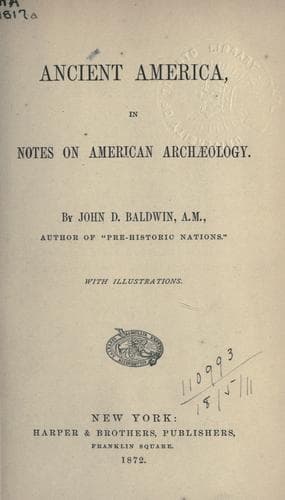
Ancient America, in Notes on American ArchaeologyBaldwin, John D. (John Denison)
History
Ancient America, in Notes on American Archaeology
Baldwin, John D. (John Denison)
America -- Antiquities; America -- Discovery and exploration -- Pre-Columbian; Indians -- Antiquities
We can not reasonably refuse to give some attention to their chronology,
even while doubting its value as a means of fixing dates and measuring
historical periods. Its method was to count by equal periods of years,
as we count by centuries, and their chronology presents a series of
periods which carries back their history to a very remote time in the
past. Brasseur de Bourbourg says: “In the histories written in the
Nahuatl language, the oldest certain date is nine hundred and fifty-five
years before Christ.” This, he means, is the oldest date in the history
of the Nahuas or Toltecs which has been accurately determined. The
calculation by which it is found is quoted from the later portion of the
“Codex Chimalpopoca” as follows: “Six times 400 years plus 113 years”
previous to the year 1558 A.D. This is given as the date of a division
of the land by the Nahuas. The division was made 2513 years previous to
1558 A.D., or in 955 B.C. If this date could be accepted as authentic,
it would follow that the Nahuas or Toltecs left Huehue-Tlapalan more
than a thousand years previous to the Christian era, for they dwelt a
long time in the country of Xibalba as peaceable settlers before they
organized the civil war which raised them to power.
SOME CONFIRMATION OF THIS HISTORY.
That the ancient history of the country was something like what is
reported in the old writings seems not improbable when we consider the
condition in which the native population was found three hundred and
fifty years ago. This shows that Mexico and Central America had been
subjected to disrupting political changes caused by violent transfers of
supreme influence from one people to another several times in the course
of a long history. Such a history is indicated by the monuments, and its
traces were noticeable in peculiarities of the native inhabitants of the
various districts at the time of the Spanish Conquest. They are still
manifest to travelers who study the existing representatives of the old
race and the old dialects sufficiently to find them. There were several
distinct families or groups of language, and, in many cases, the people
represented by each family of dialects were in a state of separation or
disruption. To a considerable extent they existed in fragmentary
communities, sometimes widely separated.
Public-domain text, read in full here on John Shaqi.
Reviews
Reviews
No reviews yet
Be the first to share your thoughts on this work.
Elsewhere in the archive
Join the Discussion
Join the discussion
Sign in to leave a comment or review.
Sign InorCreate an account