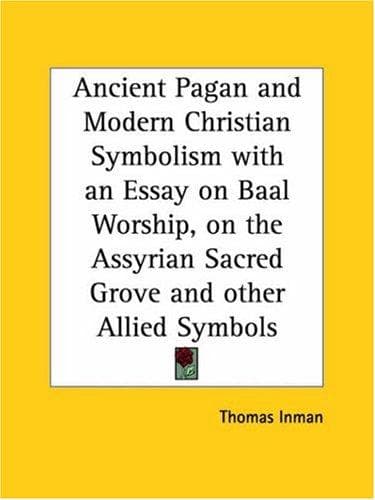
Ancient Pagan and Modern Christian Symbolism: With an Essay on Baal Worship, on the Assyrian Sacred "Grove," and Other Allied SymbolsInman, Thomas
Religion
Ancient Pagan and Modern Christian Symbolism: With an Essay on Baal Worship, on the Assyrian Sacred "Grove," and Other Allied Symbols
Inman, Thomas
Christian art and symbolism; Symbolism
"We gain infinitely more than we lose in abandoning belief
in the reality of Divine Revelation. Whilst we retain pure
and unimpaired the treasure of Christian Morality, we
relinquish nothing but the debasing elements added to it by
human superstition. We are no longer bound to believe a
theology which outrages reason and moral sense. We are freed
from base anthropomorphic views of God and His government of
the universe; and from Jewish Mythology we rise to higher
conceptions of an infinitely wise and beneficent Being,
hidden from our finite minds, it is true, in the
impenetrable glory of Divinity, but whose Laws of wondrous
comprehensiveness and perfection we ever perceive in
operation around us. We are no longer disturbed by visions
of fitful interference with the order of Nature, but we
recognise that the Being who regulates the universe is
without variableness or shadow of turning. It is singular
how little there is in the supposed Revelation of alleged
information, however incredible, regarding that which is
beyond the limits of human thought, but that little is of a
character which reason declares to be the wildest delusion.
Let no man whose belief in the reality of a Divine
Revelation may be destroyed by such an inquiry complain that
he has lost a precious possession, and that nothing is left
but a blank. The Revelation not being a reality, that which
he has lost was but an illusion, and that which is left is
the Truth. If he be content with illusions, he will speedily
be consoled; if he be a lover only of truth, instead of a
blank, he will recognise that the reality before him is full
of great peace.
"If we know less than we have supposed of man's destiny, we
may at least rejoice that we are no longer compelled to
believe that which is unworthy. The limits of thought once
attained, we may well be unmoved in the assurance that all
that we do know of the regulation of the universe being so
perfect and wise, all that we do not know must be equally
so. Here enters the true and noble Faith--which is the child
of reason. If we have believed a system, the details of
which must at one time or another have shocked the mind of
every intelligent man, and believed it simply because it was
supposed to be revealed, we may equally believe in the
wisdom and goodness of what is not revealed. The mere act of
communication to us is nothing: Faith in the perfect
ordering of all things is independent of Revelation.
Public-domain text, read in full here on John Shaqi.
Reviews
Reviews
No reviews yet
Be the first to share your thoughts on this work.
Join the Discussion
Join the discussion
Sign in to leave a comment or review.
Sign InorCreate an account