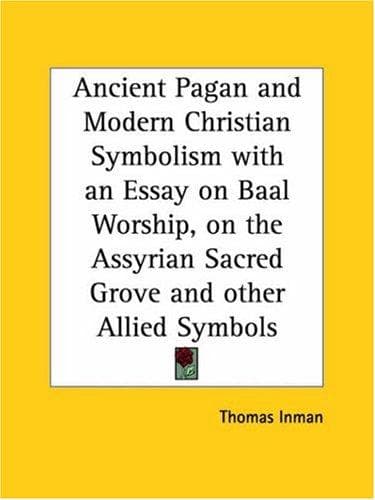
Ancient Pagan and Modern Christian Symbolism: With an Essay on Baal Worship, on the Assyrian Sacred "Grove," and Other Allied Symbols — John Shaqi
Ancient Pagan and Modern Christian Symbolism: With an Essay on Baal Worship, on the Assyrian Sacred "Grove," and Other Allied SymbolsInman, Thomas
Religion
Ancient Pagan and Modern Christian Symbolism: With an Essay on Baal Worship, on the Assyrian Sacred "Grove," and Other Allied Symbols
Inman, Thomas
Christian art and symbolism; Symbolism
These last three sentences deserve close attention, for some individuals
have, in somewhat of a senseless fashion, objected, that a person who
can see in a tortoise an emblem of the male, and in a horse-shoe an
effigy of the female organ, must be quite too fantastical to deserve
notice. But to me, as to other inquirers, these things are simply what
they appear to be when they are seen in common life. Yet when the former
creature occupies a large space in mythology; when the Hindoo places it
as the being upon which the world stands, and the Greeks represent one
Venus as resting upon a tortoise and another on a goat; and when one
knows that in days gone by, in which people were less refined, the
[--Greek--] was displayed where the horse-shoe is now, and that some
curiously mysterious attributes were assigned to the part in question;
we cannot refuse to see the thing signified in the sign.
Again, inasmuch as what we may call the most prominent part of the
tripliform organ was naturally changeable in character, being at one
time soft, small, and pendent, and at another hard, large, and upright,
those animals that resembled it in these respects became symbolical. Two
serpents, therefore, one Indian, and the other Egyptian, both of which
are able to distend their heads and necks, and to raise them up erect,
were emblematic, and each in its respective country typified the father,
the great Creator. In like manner, another portion of the triad was
regarded as similar in shape and size to the common hen's egg. As the
celebrated physiologist, Haller, remarked, "Omne vivum ex ovo" every
living thing comes from an egg; so more ancient biologists recognised
that the dual part of the tripliform organ was as essential to the
creation of a new being as the central pillar. Hence an egg and a
serpent became a characteristic of "the Father," El, Ab, Ach, Baal,
Asher, Melech, Adonai, Jahu, etc. When to this was added a half moon,
as in certain Tyrian coins, the trinity and unity were symbolised, and
a faith expressed like the one held in modern Rome, that the mother of
creation is co-equal with the father; the one seduces by her charms, and
the other makes them fructify.
To the Englishman, who, as a rule, avoids talking upon the subject which
forms the basis of many an ancient religion, it may seem incredible that
any individual, or set of writers, could have exercised their ingenuity
in finding circumlocutory euphemisms for things which, though natural,
are rarely named. Yet the wonder ceases when we find, in the writings of
our lively neighbours, the French, a host of words intended to describe
the parts referred to, which correspond wholly with the pictorial
emblems adopted by the Greeks and others.
Public-domain text, read in full here on John Shaqi.
Reviews
Reviews
No reviews yet
Be the first to share your thoughts on this work.
Join the Discussion
Join the discussion
Sign in to leave a comment or review.
Sign InorCreate an account