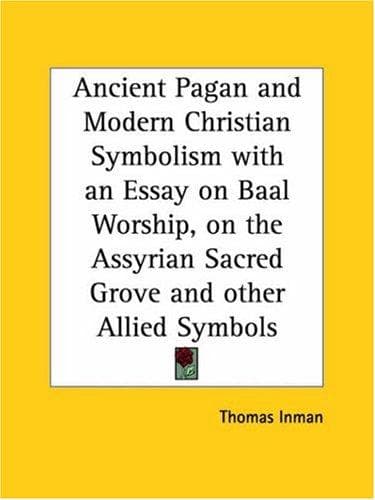
Ancient Pagan and Modern Christian Symbolism: With an Essay on Baal Worship, on the Assyrian Sacred "Grove," and Other Allied SymbolsInman, Thomas
Religion
Ancient Pagan and Modern Christian Symbolism: With an Essay on Baal Worship, on the Assyrian Sacred "Grove," and Other Allied Symbols
Inman, Thomas
Christian art and symbolism; Symbolism
A young Romanist convert, as we have recently seen, is discouraged
from persevering in the study of history and logic; a Presbyterian is
persecuted, as far as the law of the land permits, if he should engage
in an honest study of the Bible, of the God which it presents for our
worship, and of the laws that it enforces. A bishop of the Church of
England is visited by the puny and spiteful efforts of some of his
nominal equals if he ventures to treat Jewish writings as other critics
study the tomes of Livy or of Herodotus.
One set of men have banded together to elect a god on earth, and
endeavour to coerce their fellow-mortals to believe that a selection
by a few old cardinals can make the one whom they choose to honour
"infallible."
Another set of men, who profess to eschew the idea of infallibility in a
Pope, assume that they possess the quality themselves, and endeavour to
blot out from the communion of the faithful those who differ from them
"on points which God hath left at large."
Surely, when with all our modern learning, thought, and scientific
enquiry, hierarchs still set their faces against an advance in
knowledge, and quell, if possible, every endeavour to search after
truth, we are not far wrong when we assert, that the first priests of
barbarism had no exalted views of such an abstract subject as life, in
the higher and highest senses, if indeed in any sense of the word.
Another small point of difference between my friend and me is,
whether there has been at any time a figured representation of a
kakodoemon--except since the beginning of Christianity--and if, by way
of stretching a point, we call Typhon--Satan or the Devil--by this
name, as being opposed to the Agathodoemon, whether we are justified
in providing this evil genius with wings. As far as I can judge from
Chaldean and Assyrian sculptures, wings were given to the lesser deities
as our artists assign them to modern angels. The Babylonian Apollyon,
by whatever name he went, was winged--but so were all the good gods. The
Egyptians seem to have assigned wings only to the favourable divinities.
The Jews had in their mythology a set of fiery flying serpents, but we
must notice that their cherubim and seraphim were all winged, some with
no less than three pairs--much as Hindoo gods have four heads and six,
or any other number of arms.
Mr. Newton assumes that the dragon mentioned in Rev. xii. was a winged
creature, but it is clear from the context, especially from verses 14
and 15, that he had no pinions, for he was unable to follow the woman to
whom two aerial oars had been given.
Public-domain text, read in full here on John Shaqi.
Reviews
Reviews
No reviews yet
Be the first to share your thoughts on this work.
Join the Discussion
Join the discussion
Sign in to leave a comment or review.
Sign InorCreate an account