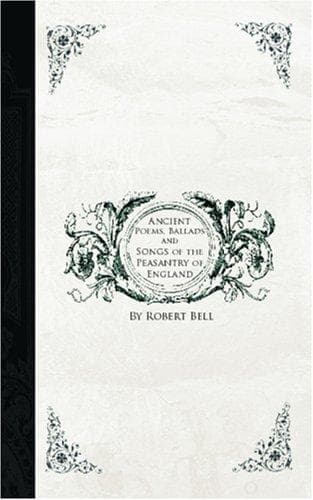
Ancient Poems, Ballads, and Songs of the Peasantry of England
General
Ancient Poems, Ballads, and Songs of the Peasantry of England
Ballads, English -- England -- Texts; Songs, English -- England -- Texts
3. I have known many young prodigals,
Which have wasted their money so fast,
That they have been driven in want,
And were forcèd to beg at the last.
4. I’d wish all men bear a good conscience,
And in all their actions be just;
For he’s a false varlet indeed
That will not be true to his trust.
And now to conclude my new song,
And draw to a perfect conclusion,
I have told you what is in my mind,
And what is my [firm] resolution.
For this I have made it appear,
And prove by experience I can,
’Tis the excellen’st thing in the world
To be a plain-dealing man.
THE VANITIES OF LIFE.
[THE following verses were copied by John Clare, the Northamptonshire
peasant, from a MS. on the fly-leaves of an old book in the possession of
a poor man, entitled _The World’s best Wealth_; _a Collection of choice
Councils in Verse and Prose_. _Printed for A. Bettesworth_, _at the Red
Lion in Paternoster-row_, 1720. They were written in a ‘crabbed, quaint
hand, and difficult to decipher.’ Clare remitted the poem (along with
the original MS.) to Montgomery, the author of _The World before the
Flood_, &c. &c., by whom it was published in the _Sheffield Iris_.
Montgomery’s criticism is as follows:—‘Long as the poem appears to the
eye, it will abundantly repay the trouble of perusal, being full of
condensed and admirable thought, as well as diversified with exuberant
imagery, and embellished with peculiar felicity of language: the moral
points in the closing couplets of the stanzas are often powerfully
enforced.’ Most readers will agree in the justice of these remarks. The
poem was, probably, as Clare supposes, written about the commencement of
the 18th century; and the unknown author appears to have been deeply
imbued with the spirit of the popular devotional writers of the preceding
century, as Herbert, Quarles, &c., but seems to have modelled his
smoother and more elegant versification after that of the poetic school
of his own times.]
‘Vanity of vanities, all is vanity.’—SOLOMON.
WHAT are life’s joys and gains?
What pleasures crowd its ways,
That man should take such pains
To seek them all his days?
Sift this untoward strife
On which thy mind is bent,
See if this chaff of life
Is worth the trouble spent.
Is pride thy heart’s desire?
Is power thy climbing aim?
Is love thy folly’s fire?
Is wealth thy restless game?
Pride, power, love, wealth and all,
Time’s touchstone shall destroy,
And, like base coin, prove all
Vain substitutes for joy.
Dost think that pride exalts
Thyself in other’s eyes,
And hides thy folly’s faults,
Which reason will despise?
Dost strut, and turn, and stride,
Like walking weathercocks?
The shadow by thy side
Becomes thy ape, and mocks.
Public-domain text, read in full here on John Shaqi.
Reviews
Reviews
No reviews yet
Be the first to share your thoughts on this work.
Join the Discussion
Join the discussion
Sign in to leave a comment or review.
Sign InorCreate an account