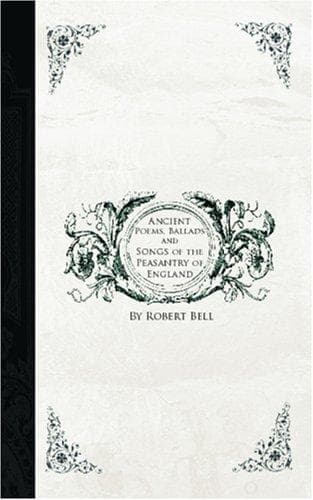
Ancient Poems, Ballads, and Songs of the Peasantry of England
General
Ancient Poems, Ballads, and Songs of the Peasantry of England
Ballads, English -- England -- Texts; Songs, English -- England -- Texts
Kind sir! it would be bad if none could be had
Those tables for to wait upon;
There is no lord, duke, nor squire, nor member for the shire,
Can do without a servingman.
HUSBANDMAN.
But, Jack! it would be worse if there was none of us
To follow the plowing of the land;
There is neither king, lord, nor squire, nor member for the shire,
Can do without the husbandman.
SERVINGMAN.
Kind sir! I must confess’t, and I humbly protest
I will give you the uppermost hand;
Although your labour’s painful, and mine it is so very gainful,
I wish I were a husbandman.
HUSBANDMAN.
So come now, let us all, both great as well as small,
Pray for the grain of our land;
And let us, whatsoever, do all our best endeavour,
For to maintain the good husbandman.
THE CATHOLICK.
[THE following ingenious production has been copied literally from a
broadside posted against the ‘parlour’ wall of a country inn in
Gloucestershire. The verses are susceptible of two interpretations,
being Catholic if read in the columns, but Protestant if read across.]
I HOLD as faith What _England’s church_ alows
What _Rome’s_ church saith My conscience disavows
Where the _King’s_ head That _church_ can have no
The flocks misled shame
Where the _altars_ drest That holds the _Pope_
The peoples blest supreame.
He’s but an asse There’s service scarce divine
Who shuns the _masse_ With table, bread, and wine.
Who the _communion_ flies
Is _catholick_ and wise.
London: printed for George Eversden, at the signe of the
Maidenhead, in St. Powle’s Church-yard, 1655. _Cum privilegio_.
Ballads.
THE THREE KNIGHTS.
(TRADITIONAL.)
[_The Three Knights_ was first printed by the late Davies Gilbert,
F.R.S., in the appendix to his work on _Christmas Carols_. Mr. Gilbert
thought that some verses were wanting after the eighth stanza; but we
entertain a different opinion. A conjectural emendation made in the
ninth verse, viz., the substitution of _far_ for _for_, seems to render
the ballad perfect. The ballad is still popular amongst the peasantry in
the West of England. The tune is given by Gilbert. The refrain, in the
second and fourth lines, printed with the first verse, should be repeated
in recitation in every verse.]
Public-domain text, read in full here on John Shaqi.
Reviews
Reviews
No reviews yet
Be the first to share your thoughts on this work.
Join the Discussion
Join the discussion
Sign in to leave a comment or review.
Sign InorCreate an account