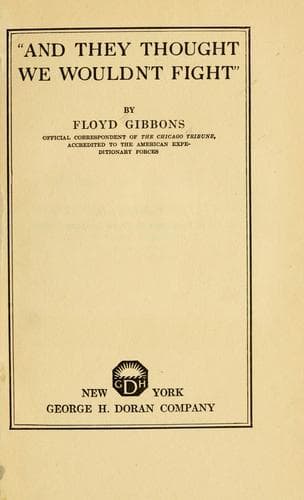
"And they thought we wouldn't fight"Gibbons, Floyd Phillips
History
"And they thought we wouldn't fight"
Gibbons, Floyd Phillips
World War, 1914-1918 -- Campaigns -- Western Front; World War, 1914-1918 -- Personal narratives
The sharp shattering crash of the guns reaches our ears almost on the
instant. The forest shakes and our tree top sways with the slam of the
heavies close by. The riven air whimpers with the husky whispering of
the rushing load of metal bolts passing above us.
Looking up into that void, we deny the uselessness of the act and seek
in vain to follow the trains of those unseen things that make the air
electric with their presence. We hear them coming, passing, going, but
see not one of them.
"There's whole blacksmith's shops sailing over our heads on the way to
Germany," Pat Guahn shouts in my ear. "I guess the Dutchman sure knows
how to call for help. He doesn't care for that first wallop, and he
thinks he would like about a half million reserves from the Russian
front."
"That darkness out in No Man's Land don't make any hit with him either,"
Stanton contributes. "He's got it lit up so bright I'm homesick for
Broadway."
Now comes the thunder of the shell arrivals. You know the old covered
wooden bridges that are still to be found in the country. Have you ever
heard a team of horses and a farm wagon thumping and rumbling over such
a bridge on the trot?
Multiply the horse team a thousand times. Lash the animals from the trot
to the wild gallop. Imagine the sound of their stampede through the
echoing wooden structure and you approach in volume and effect the
rumble and roar of the steel as it rained down on that little German
salient that night.
"Listen to them babies bustin'," says Griffin. "I'm betting them
groundhogs is sure huntin' their holes right now and trying to dig clear
through to China."
That was the sound and sight of that opening salvo from all guns, from
the small trench mortars in the line, the lightest field pieces behind
them, the heavy field pieces about us and the ponderous railroad
artillery located behind us.
Its crash has slashed the inkiness in front of us with a lurid red
meridian. I don't know how many hands had pulled lanyards on exactly the
same instant but the consequent spread of fire looked like one
continuous flame.
Now the "seventy-fives" are speaking, not in unison, but at various
speeds, limited only by the utmost celerity of the sweating gun crews.
But the German front line is not the only locality receiving unsolicited
attention. Enemy gun positions far behind the lines are being plastered
with high explosives and anesthetised with gas shells.
So effective is the American artillery neutralisation of the German
batteries, that it is between fifteen and twenty minutes before the
first enemy gun replies to the terrific barrage. And though expected
momentarily, a German counter barrage fails to materialise.
Public-domain text, read in full here on John Shaqi.
Reviews
Reviews
No reviews yet
Be the first to share your thoughts on this work.
Elsewhere in the archive
Join the Discussion
Join the discussion
Sign in to leave a comment or review.
Sign InorCreate an account