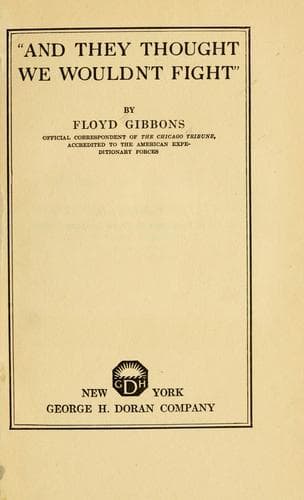
"And they thought we wouldn't fight"Gibbons, Floyd Phillips
History
"And they thought we wouldn't fight"
Gibbons, Floyd Phillips
World War, 1914-1918 -- Campaigns -- Western Front; World War, 1914-1918 -- Personal narratives
In our tree top we wait for the enemy's counter shelling but the
retaliation does not develop. When occupying an exposed position, the
suspense of waiting for an impending blow increases in tenseness as the
delay continues and the expectations remain unrealised. With no
inclination to be unreasonable, one even prays for the speedy delivery
of the blow in the same way that the man with the aching tooth urges the
dentist to speed up and have it over with.
"Why in hell don't they come back at us?" Griffin asks. "I've had myself
all tuned up for the last twenty minutes to have a leg blown off and be
thankful. I hate this waiting stuff."
"Keep your shirt on, Pete," Stanton remarks. "Give 'em a chance to get
their breath and come out of their holes. That barrage drove 'em down a
couple hundred feet into the ground and they haven't any elevators to
come up on. We'll hear from 'em soon enough."
We did, but it was not more than a whisper as compared with what they
were receiving from our side of the line. The German artillery came into
lethargic action after the American barrage had been in constant
operation for thirty minutes and then the enemy's fire was only
desultory. Only an occasional shell from Kulturland came our way, and
even they carried a rather tired, listless buzz, as though they didn't
know exactly where they were going and didn't care.
Six or eight of them hummed along a harmless orbit not far above our
tree top and fell in the forest. It certainly looked as though we were
shooting all the hard-stuff and the German end of the fireworks party
was all coloured lights and Roman candles. Of the six shells that passed
us, three failed to explode upon landing.
"That makes three dubs," said Guahn.
"You don't mean dubs," Stanton corrected him, "you mean duds and even
then you are wrong. Those were gas pills. They just crack open quietly
so you don't know it until you've sniffed yourself dead. Listen, you'll
hear the gas alert soon."
Even as he spoke, we heard through the firing the throaty gurgling of
the sirens. The alarm started on our right and spread from station to
station through the woods. We adjusted the respirators and turned our
muffled faces toward the firing line. Through the moisture fogged
glasses of my mask, I looked first upon my companions on this rustic
scaffold above the forest.
War's demands had removed our appearances far from the human. Our heads
were topped with uncomfortable steel casques, harder than the backs of
turtles. Our eyes were large, flat, round glazed surfaces unblinking and
owl-like. Our faces were shapeless folds of black rubber cloth. Our
lungs sucked air through tubes from a canvass bag under our chins and we
were inhabiting a tree top like a family of apes. It really required
imagination to make it seem real.
"Looks like the party is over," came the muffled remark from the masked
figure beside me. The cannonading was dying down appreciably. The
blinking line of lights in front of us grew less.
Public-domain text, read in full here on John Shaqi.
Reviews
Reviews
No reviews yet
Be the first to share your thoughts on this work.
Elsewhere in the archive
Join the Discussion
Join the discussion
Sign in to leave a comment or review.
Sign InorCreate an account