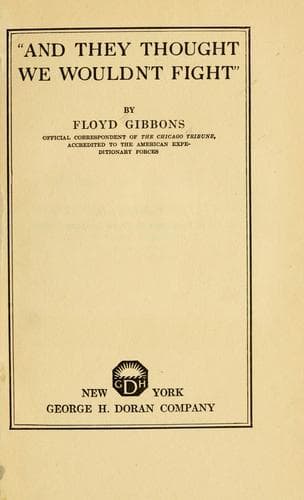
"And they thought we wouldn't fight"Gibbons, Floyd Phillips
History
"And they thought we wouldn't fight"
Gibbons, Floyd Phillips
World War, 1914-1918 -- Campaigns -- Western Front; World War, 1914-1918 -- Personal narratives
A terrific upward blast of red and green flame from the ground close to
our tree, reminded us that one heavy still remained under firing orders.
The flash seen through the forest revealed in intricate tracings the
intertwining limbs and branches of the trees. It presented the
appearance of a piece of strong black lace spread out and held at arm's
length in front of a glowing grate.
From the German lines an increased number of flares shot skyward and as
the cannon cracks ceased, save for isolated booms, the enemy machine
guns could be heard at work, riveting the night with sprays of lead and
sounding for all the world like a scourge of hungry woodpeckers.
"God help any of the doughboys that are going up against any of that
stuff," Griffin observed through his mask.
"Don't worry about our doughboys," replied Stanton; "they are all safe
in their trenches now. That's most likely the reason why our guns were
ordered to lay off. I guess Fritzie got busy with his typewriters too
late."
I descended the tree, leaving my companions to wait for the orders
necessary for their departure. Unfamiliar with the unmarked paths of
the forest and guided only as to general directions, I made my way
through the trees some distance in search of the road back from the
front.
A number of mud and water-filled shell holes intervened to make the
exertion greater and consequently the demand upon lungs for air greater.
After floundering several kilometres through a strange forest with a gas
mask on, one begins to appreciate the temptation that comes to tear off
the stifling nose bag and risk asphyxiation for just one breath of fresh
air.
A babel of voices in the darkness to one side guided me to a log cabin
where I learned from a sentry that the gas scare had just been called
off. Continuing on the road, I collided head on in the darkness with a
walking horse. Its rider swore and so did I, with slightly the advantage
over him as his head was still encased. I told him the gas alarm was off
and he tore away the mask with a sigh of relief. I left him while he was
removing the horse's gas mask.
A light snow was beginning to fall as I said good-night to the battalion
commander in front of his roadside shack. A party of mounted runners was
passing on the way to their quarters. With an admirable lack of dignity
quite becoming a national guard cavalry major in command of regular army
artillery, he said:
"Good-night, men, we licked hell out of them."
The Toul sector, during its occupation by Americans, always maintained a
high daily rating of artillery activity. The opposing forces were
continually planning surprises on one another. At any minute of the
night or day a terrific bombardment of high explosive or gas might break
out on either side. Both sides operated their sound ranging apparatus
to a rather high degree of efficiency.
Public-domain text, read in full here on John Shaqi.
Reviews
Reviews
No reviews yet
Be the first to share your thoughts on this work.
Elsewhere in the archive
Join the Discussion
Join the discussion
Sign in to leave a comment or review.
Sign InorCreate an account