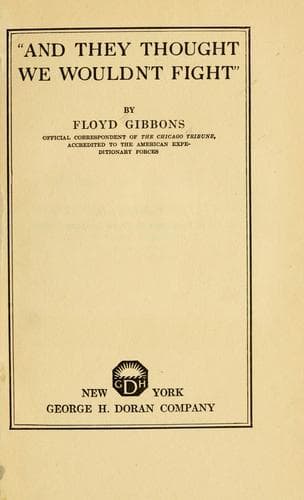
"And they thought we wouldn't fight"Gibbons, Floyd Phillips
History
"And they thought we wouldn't fight"
Gibbons, Floyd Phillips
World War, 1914-1918 -- Campaigns -- Western Front; World War, 1914-1918 -- Personal narratives
That night we made final arrangements for the morrow's move. I
travelled with the artillery where orders were received for the
reduction of all packs to the lightest possible as all men would be
dismounted and the baggage wagons would be reserved for food, ammunition
and officers' luggage only. Officers' packs, by the same order, had to
shrink from one hundred and fifty pounds to twenty.
There were many misgivings that night as owners were forced to discard
cherished belongings. Cumbersome camp paraphernalia, rubber bathtubs,
pneumatic mattresses, extra blankets, socks, sweaters, etc., all parted
company from erstwhile owners. That order caused many a heart-break and
the abandonment of thousands of dollars' worth of personal equipment in
our area.
I have no doubt that some of the village maidens were surprised at the
remarkable generosity of officers and men who presented them with
expensive toilet sets. Marie at the village _estaminet_ received five of
them all fitted in neat leather rolls and inscribed with as many
different sets of initials. The old men of the town gloried in the
sweaters, woollen socks and underwear.
There was no chance to fudge on the slim baggage order. An officer,
bound by duty, weighed each officer's kit as it reached the baggage
wagons and those tipping the scales at more than the prescribed twenty
pounds, were thrown out entirely. I happened to be watching the loading
when it came turn for the regimental band to stow away its encased
instruments in one wagon. It must be remembered that musicians at the
front are stretcher bearers. The baggage judge lifted the case
containing the bass horn.
"No horn in the world ever weighed that much," he said. "Open it up,"
was the terse command. The case was opened and the base horn pulled out.
The baggage officer began operations on the funnel. I watched him
remove from the horn's interior two spare blankets, four pairs of socks,
an extra pair of pants and a carton of cigarettes. He then inserted his
arm up to the shoulder in the instrument's innards and brought forth two
apples, a small tin of blackberry jam and an egg wrapped in an
undershirt.
The man who played the "umpah umpah" in the band was heartbroken. The
clarinet player, who had watched the operation and whose case followed
for inspection, saved the inspector trouble by removing an easily hidden
chain of sausage. I noticed one musician who was observing the ruthless
pillage but, strangely, his countenance was the opposite of the others.
He was actually smiling. I inquired the cause of his mirth.
"When we packed up, those guys with the big hollow instruments all had
the laugh on me," he said. "Now I've got it on them. I play the
piccolo."
Public-domain text, read in full here on John Shaqi.
Reviews
Reviews
No reviews yet
Be the first to share your thoughts on this work.
Elsewhere in the archive
Join the Discussion
Join the discussion
Sign in to leave a comment or review.
Sign InorCreate an account