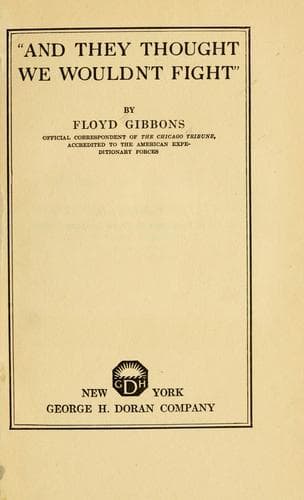
"And they thought we wouldn't fight"Gibbons, Floyd Phillips
History
"And they thought we wouldn't fight"
Gibbons, Floyd Phillips
World War, 1914-1918 -- Campaigns -- Western Front; World War, 1914-1918 -- Personal narratives
All the mounted men under the rank of battery commanders were dismounted
in order to save the horses for any possibilities in the war of
movement. A dismounted artilleryman carrying a pack and also armed with
a rifle, is a most disconsolate subject to view just prior to setting
out for a long tramp. In his opinion, he has been reduced too near the
status of the despised doughboy.
It really doesn't seem like artillery unless one has a horse to ride and
a saddle to strap one's pack on. In the lineup before we started, I saw
two of these gunners standing by weighted down with their cumbersome,
unaccustomed packs. They were backed against a stone wall and were
easing their burdens by resting the packs on the stone ledge. Another
one similarly burdened passed and, in a most serious tone, inquired:
"Say, would either of you fellows like to buy another blanket roll?" The
reply of two dejected gunners would bar this story from publication.
We were on the march early in the morning, but not without some initial
confusion by reason of the inevitable higher orders which always come at
the last minute to change programmes. On parallel roads through that
zone of unmarred beauty which the Normans knew, our columns swung along
the dusty highroads.
There were many who held that America would not be thoroughly awake to
the full meaning of her participation in the war until the day there
came back from the battlefields a long list of casualties--a division
wiped out or decimated. Many had heard the opinions expressed in France
and many firmly believed that nothing short of such a shock would arouse
our nation to the exertion of the power and speed necessary to save the
Allied cause from defeat.
On this march, that thought recurred to some and perhaps to many who
refrained soberly from placing it in words. I knew several in the
organisation who felt that we were on our way to that sacrifice. I can
not estimate in how many minds the thought became tangible, but among
several whom I heard seriously discussing the matter, I found a perfect
willingness on their part to meet the unknown--to march on to the
sacrifice with the feeling that if the loss of their life would help
bring about a greater prosecution of the war by our country, then they
would not have died in vain.
If this was the underlying spirit, it had no effect whatever upon
outward appearances which could hardly be better described than with
Cliff Raymond's lilting words: "There are roses in their rifles just the
same." If this move was on to the sacrifice--if death awaited at the
end of the road, then those men were marching toward it with a song.
Public-domain text, read in full here on John Shaqi.
Reviews
Reviews
No reviews yet
Be the first to share your thoughts on this work.
Elsewhere in the archive
Join the Discussion
Join the discussion
Sign in to leave a comment or review.
Sign InorCreate an account