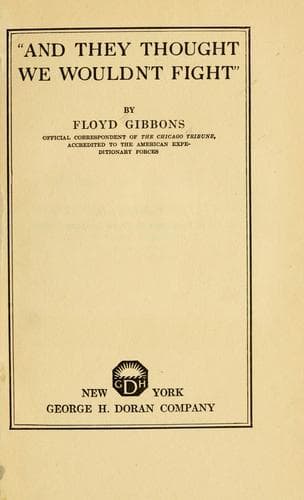
"And they thought we wouldn't fight"Gibbons, Floyd Phillips
History
"And they thought we wouldn't fight"
Gibbons, Floyd Phillips
World War, 1914-1918 -- Campaigns -- Western Front; World War, 1914-1918 -- Personal narratives
So as not to impede traffic through the place, it had become necessary
to elevate the field telephone wires from the ground and send them
across the road overhead. The crucifix in the centre of the place had
presented itself as excellent support for this wire and the sons of the
prophet had utilised it with no intention of disrespect. The uplifted
right knee of the figure on the cross was insulated and wired. War, the
moderniser and mocker of Christ, seemed to have devised new pain for the
Teacher of Peace. The crucifixion had become the electrocution.
At the foot of the cross had been nailed a rudely made sign conveying to
all who passed the French warning that this was an exposed crossing and
should be negotiated rapidly. Fifty yards away another board bore the
red letters R. A. S. and by following the direction indicated by arrows,
one arrived at the cellar in which the American doctor had established a
Relief Aid Station. The Medico had furnished his subterranean apartments
with furniture removed from the house above.
"Might as well bring it down here and make the boys comfortable," he
said, "as to leave it up there and let shells make kindling out of it.
Funny thing about these cellars. Ones with western exposure--that is,
with doors and ventilators opening on the side away from the enemy seem
scarcest. That seems to have been enough to have revived all that talk
about German architects having had something to do with the erection of
those buildings before the war. You remember at one time it was said
that a number of houses on the front had been found to have plaster
walls on the side nearest the enemy and stone walls on the other side.
There might be something to it, but I doubt it."
Across the street an American battalion headquarters had been
established on the first floor and in the basement of the house, which
appeared the most pretentious in the village. Telephone wires now
entered the building through broken window panes, and within maps had
been tacked to plaster walls and the furniture submitted to the hard
usage demanded by war. An old man conspicuous by his civilian clothes
wandered about the yard here and there, picking up some stray implement
or nick-nack, hanging it up on a wall or placing it carefully aside.
"There's a tragedy," the battalion commander told me. "That man is mayor
of this town. He was forced to flee with the rest of the civilians. He
returned to-day to look over the ruins. This is his house we occupy. I
explained that much of it is as we found it, but that we undoubtedly
have broken some things. I could see that every broken chair and window
and plate meant a heart throb to him, but he only looked up at me with
his wrinkled old face and smiled as he said, 'It is all right, Monsieur.
I understand. _C'est la guerre._'"
Public-domain text, read in full here on John Shaqi.
Reviews
Reviews
No reviews yet
Be the first to share your thoughts on this work.
Elsewhere in the archive
Join the Discussion
Join the discussion
Sign in to leave a comment or review.
Sign InorCreate an account