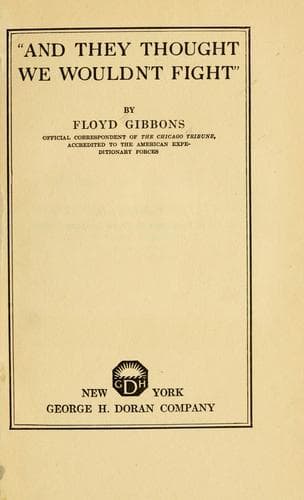
"And they thought we wouldn't fight"Gibbons, Floyd Phillips
History
"And they thought we wouldn't fight"
Gibbons, Floyd Phillips
World War, 1914-1918 -- Campaigns -- Western Front; World War, 1914-1918 -- Personal narratives
The old man opened one of his barn doors, revealing a floor littered
with straw and a fringe of hobnailed American boots. A night-working
detail was asleep in blankets. A sleepy voice growled out something
about closing the door again and the old man with a polite,
"_Pardonnez-moi, messieurs_," swung the wooden portal softly shut. His
home--his house--his barn--his straw--_c'est la guerre_.
An evening meal of "corn willy" served on some of the Mayor's remaining
chinaware, was concluded by a final course of fresh spring onions. These
came from the Mayor's own garden just outside the door. As the cook
affirmed, it was no difficulty to gather them.
"Every night Germans drop shells in the garden," he said. "I don't even
have to pull 'em. Just go out in the morning and pick 'em up off the
ground."
I spent part of the night in gun pits along the road side, bordering the
town. This particular battery of heavies was engaged on a night long
programme of interdiction fire laid down with irregular intensity on
cross roads and communication points in the enemy's back areas. Under
screens of camouflage netting, these howitzers with mottled bores
squatting frog-like on their carriages, intermittently vomited flame,
red, green and orange. The detonations were ear-splitting and cannoneers
relieved the recurring shocks by clapping their hands to the sides of
their head and balancing on the toes each time the lanyard was pulled.
Infantry reserves were swinging along in the road directly in back of
the guns. They were moving up to forward positions and they sang in an
undertone as they moved in open order.
"Glor--ree--us, Glor--ree--us!
One keg of beer for the four of us.
Glory be to Mike there are no more of us,
For four of us can drink it all alone."
Some of these marchers would come during an interval of silence to a
position on the road not ten feet from a darkened, camouflaged howitzer
just as it would shatter the air with a deafening crash. The suddenness
and unexpectedness of the detonation would make the marchers start and
jump involuntarily. Upon such occasions, the gun crews would laugh
heartily and indulge in good natured raillery with the infantrymen.
"Whoa, Johnny Doughboy, don't you get frightened. We were just shipping
a load of sauerkraut to the Kaiser," said one ear-hardened gunner.
"Haven't you heard the orders against running your horses? Come down to
a gallop and take it easy."
"Gwan, you leatherneck," returns an infantryman, "You smell like a
livery stable. Better trade that pitchfork for a bayonet and come on up
where there's some fighting."
"Don't worry about the fighting, little doughboy," came another voice
from the dark gun pit. "This is a tray forte sector. If you don't get
killed the first eight days, the orders is to shoot you for loafing.
You're marching over what's called 'the road you don't come back on.'"
Public-domain text, read in full here on John Shaqi.
Reviews
Reviews
No reviews yet
Be the first to share your thoughts on this work.
Elsewhere in the archive
Join the Discussion
Join the discussion
Sign in to leave a comment or review.
Sign InorCreate an account