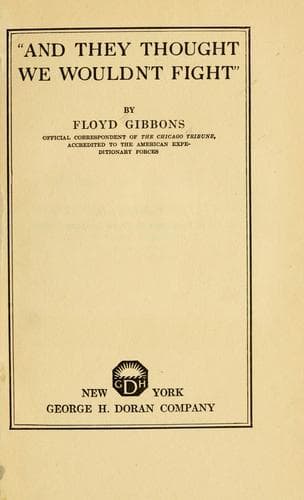
"And they thought we wouldn't fight"Gibbons, Floyd Phillips
History
"And they thought we wouldn't fight"
Gibbons, Floyd Phillips
World War, 1914-1918 -- Campaigns -- Western Front; World War, 1914-1918 -- Personal narratives
The number of arrivals by way of the air in that particular village
every day numbered high in the thousands. Under such conditions, no
life-loving human could have failed to produce the last degree of
utility out of a spade. The continual dropping of shells in the ruins
and the unending fountains of chalk dust and dirt left little for the
imagination, but one officer told me that it reminded him of living in a
room where some one was eternally beating the carpet.
This taste of the war of semi-movement was appreciated by the American
soldier. It had in it a dash of novelty, lacking in the position warfare
to which he had become accustomed in the mud and marsh of the Moselle
and the Meuse. For one thing, there were better and cleaner billets than
had ever been encountered before by our men. Fresh, unthrashed oats and
fragrant hay had been found in the hurriedly abandoned lofts back of the
line and in the caves and cellars nearer the front.
In many places the men were sleeping on feather mattresses in
old-fashioned wooden bedsteads that had been removed from jeopardy above
ground to comparative safety below. Whole caves were furnished, and not
badly furnished, by this salvage of furniture, much of which would have
brought fancy prices in any collection of antiques.
Forced to a recognition solely of intrinsic values, our men made prompt
utilisation of much of the material abandoned by the civilian
population. Home in the field is where a soldier sleeps and after all,
why not have it as comfortable as his surroundings will afford? Those
caves and vegetable cellars, many with walls and vaulted ceilings of
clean red brick or white blocks of chalk, constituted excellent shelters
from shell splinters and even protected the men from direct hits by
missiles of small calibre.
Beyond the villages, our riflemen found protection in quickly scraped
holes in the ground. There were some trenches but they were not
contiguous. "No Man's Land" was an area of uncertain boundary. Our
gunners had quarters burrowed into the chalk not far from their gun
pits. All communication and the bringing up of shells and food were
conducted under cover of darkness. Under such conditions, we lived and
waited for the order to go forward.
Our sector in that battle of the Somme was so situated that the opposing
lines ran north and south. The enemy was between us and the rising sun.
Behind our rear echelons was the main road between Amiens and Beauvais.
Amiens, the objective of the German drive, was thirty-five kilometres
away on our left, Beauvais was the same distance on our right and two
hours by train from Paris.
We were eager for the fight. The graves of our dead dotted new fields in
France. We were holding with the French on the Picardy line. We were
between the Germans and the sea. We were before Cantigny.
CHAPTER XIII
THE RUSH OF THE RAIDERS--"ZERO AT 2 A. M."
Public-domain text, read in full here on John Shaqi.
Reviews
Reviews
No reviews yet
Be the first to share your thoughts on this work.
Elsewhere in the archive
Join the Discussion
Join the discussion
Sign in to leave a comment or review.
Sign InorCreate an account