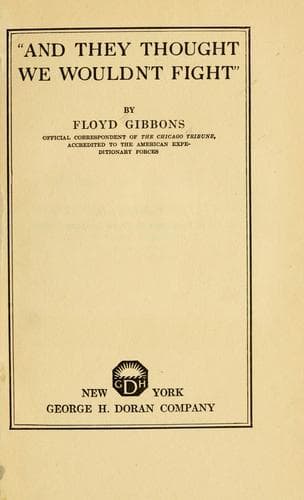
"And they thought we wouldn't fight"Gibbons, Floyd Phillips
History
"And they thought we wouldn't fight"
Gibbons, Floyd Phillips
World War, 1914-1918 -- Campaigns -- Western Front; World War, 1914-1918 -- Personal narratives
On every hand were evidences of the reborn war of semi-movement. One day
I would see a battery of light guns swing into position by a roadside,
see an observing officer mount by ladder to a tree top and direct the
firing of numberless rounds into the rumbling east. By the next morning,
they would have changed position, rumbled off to other parts, leaving
beside the road only the marks of their cannon wheels and mounds of
empty shell cases.
Between our infantry lines and those of the German, there was yet to
grow the complete web of woven wire entanglements that marred the
landscapes on the long established fronts. Still standing, silent
sentinels over some of our front line positions were trees, church
steeples, dwellings and barns that as yet had not been levelled to the
ground. Dugouts had begun to show their entrances in the surface of the
ground and cross roads had started to sprout with rudely constructed
shelters. Fat sandbags were just taking the places of potted geraniums
on the sills of first floor windows. War's toll was being exacted daily,
but the country had yet to pay the full price. It was going through that
process of degeneration toward the stripped and barren but it still held
much of its erstwhile beauty.
Those days before Cantigny were marked by particularly heavy artillery
fire. The ordnance duel was unrelenting and the daily exchange of shells
reached an aggregate far in excess of anything that the First Division
had ever experienced before.
Nightly the back areas of the front were shattered with shells. The
German was much interested in preventing us from bringing up supplies
and munition. We manifested the same interest toward him. American
batteries firing at long range, harassed the road intersections behind
the enemy's line and wooded places where relief troops might have been
assembled under cover of darkness. The expenditure of shells was
enormous but it continued practically twenty-four hours a day. German
prisoners, shaking from the nervous effects of the pounding, certified
to the untiring efforts of our gunners.
The small nameless village that we occupied almost opposite the German
position in Cantigny seemed to receive particular attention from the
enemy artillery. In retaliation, our guns almost levelled Cantigny and a
nearby village which the enemy occupied. Every hour, under the rain of
death, the work of digging was continued and the men doing it needed no
urging from their officers. There was something sinister and emphatic
about the whine of a "two ten German H. E." that inspired one with a
desire to start for the antipodes by the shortest and most direct route.
Public-domain text, read in full here on John Shaqi.
Reviews
Reviews
No reviews yet
Be the first to share your thoughts on this work.
Elsewhere in the archive
Join the Discussion
Join the discussion
Sign in to leave a comment or review.
Sign InorCreate an account