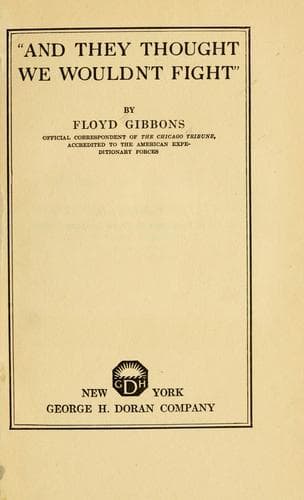
"And they thought we wouldn't fight"Gibbons, Floyd Phillips
History
"And they thought we wouldn't fight"
Gibbons, Floyd Phillips
World War, 1914-1918 -- Campaigns -- Western Front; World War, 1914-1918 -- Personal narratives
By 10:30 that night the completion of the movement was signalised by a
terrific explosion, as the French colonials blew up one of the stone
bridges over which they had withdrawn. But the destruction of the bridge
had cut off the little band of Americans and left them almost surrounded
by the enemy on the north bank of the river, which was now becoming
strongly populated by the enemy. Through the darkness could be heard the
sound of shuffling, hobnailed boots, and even above the crack of the
guns there came the weird swish of the grey coats as they pushed forward
in mass formations.
The little party of thirteen Americans dismantled their guns and, with
each man carrying his allotted piece, they began working their way along
the river bank toward the main bridge, where they discovered that the
enemy was almost upon them. They immediately went into position behind
the stone parapet on the very brink of the river, and, although in
constant danger from the American fire that poured out from the south
bank, they poured streams of lead point-blank into the advancing German
ranks.
The Americans on the south bank were not aware of the plight of the
little party on the north bank. In spite of their losses, the Germans
continued their grewsome rushes toward the approaches of the iron bridge
across which our machine gunners were pouring a devastating fire.
Lieutenant Bissell and his men made one effort to cross the bridge, but
were forced to crawl back to shelter on the north bank, carrying with
them three of their wounded. They found themselves between a cross-fire.
Then Bissell, alone, approached as near as he dared, and the first
intimation that the Americans on the south bank had of the fact that
Americans were in front of them was when Lieutenant Cobey heard
Bissell's voice calling his name. A cease fire order was immediately
given and Bissell and his men rushed across the bridge, carrying their
wounded with them.
On the following day the Germans were in occupation of all the houses
facing the north bank of the river, and could be seen from time to time
darting from one shelter to another. Throughout the day their artillery
maintained a terrific downpour of shells on the positions held by our
men on the south bank. So intense was the rifle fire and activity of
snipers, that it meant death to appear in the open. The Americans manned
their guns throughout the day, but refrained from indulging in machine
gun fire because it was not desired to reveal the locations of the guns.
Nightfall approached with a quiet that was deadly ominous of impending
events.
At nine o'clock the enemy formations lunged forward to the attack. Their
dense masses charged down the streets leading toward the river. They
sang as they advanced. The orders, as revealed in documents captured
later, came straight from the high command and demanded the acquisition
of a foothold on the south bank at all costs. They paid the costs, but
never reached the south bank.
Public-domain text, read in full here on John Shaqi.
Reviews
Reviews
No reviews yet
Be the first to share your thoughts on this work.
Elsewhere in the archive
Join the Discussion
Join the discussion
Sign in to leave a comment or review.
Sign InorCreate an account