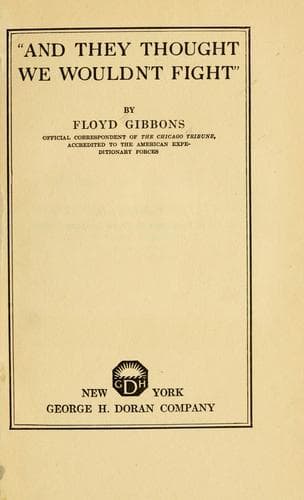
"And they thought we wouldn't fight"Gibbons, Floyd Phillips
History
"And they thought we wouldn't fight"
Gibbons, Floyd Phillips
World War, 1914-1918 -- Campaigns -- Western Front; World War, 1914-1918 -- Personal narratives
The American machine gun fire was withering. Time after time, in the
frequent rushes throughout the night, the remnants of enemy masses would
reach sometimes as far as the centre of the big bridge, but none of them
succeeded in reaching the south bank. The bridge became carpeted with
German dead and wounded. They lay thick in the open streets near the
approaches. By morning their dead were piled high on the bridge and
subsequent rushes endeavoured to advance over the bodies of their fallen
comrades. In this battle of the bridges and the streets, our men showed
a courage and determination which aroused the admiration of the French
officers, who were aware by this time that forty-eight hours before
these same American soldiers had seen battle for the first time.
Our machine gunners turned the northern bank of the river into a No
Man's Land. Their vigilance was unrelenting and every enemy attempt to
elude it met with disaster. There were serious American casualties
during that terrific fire, but they were nothing in comparison with the
thousand or more German dead that dotted the streets and clogged the
runways of the big bridge in piles. The last night of the fight enormous
charges of explosive were placed beneath the bridge and discharged.
The bridge was destroyed. High into the air were blown bits of stone,
steel, timber, debris, wreckage and the bodies of German dead, all to
fall back into the river and go bobbing up and down in the waters of the
Marne.
Thus did the Americans save the day at Chateau-Thierry, but it became
immediately necessary for the French high command to call upon our young
forces for another great effort. In response to this call, the Second
United States Division, including one brigade of the United States
Marines, the 5th and 6th Regiments, started for the front. The division
was then occupying support positions in the vicinity of Gisors behind
the Picardy line. At four o'clock on the morning of May 31st the Marine
brigade and regiments of United States infantry, the 9th and the 23rd
Regulars, boarded camions, twenty to thirty men and their equipment in
each vehicle.
They were bound eastward to the valley of the Marne. The road took them
through the string of pretty villages fifteen miles to the north of
Paris. The trucks loaded with United States troops soon became part of
the endless traffic of war that was pouring northward and eastward
toward the raging front. Our men soon became coated with the dust of the
road. The French people in the villages through which they passed at top
speed cheered them and threw flowers into the lorries.
Public-domain text, read in full here on John Shaqi.
Reviews
Reviews
No reviews yet
Be the first to share your thoughts on this work.
Elsewhere in the archive
Join the Discussion
Join the discussion
Sign in to leave a comment or review.
Sign InorCreate an account