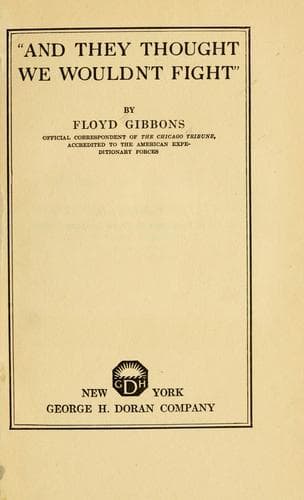
"And they thought we wouldn't fight"Gibbons, Floyd Phillips
History
"And they thought we wouldn't fight"
Gibbons, Floyd Phillips
World War, 1914-1918 -- Campaigns -- Western Front; World War, 1914-1918 -- Personal narratives
On the right Lieutenant Robertson, with twenty survivors out of his
entire platoon, emerged from the terrific enemy barrage and took the
town of Bouresches at the point of the bayonet. Captain Duncan,
receiving word that one Marine company, with a determination to engage
the enemy in hand-to-hand combat, had gone two hundred yards in advance,
raced forward on the double quick with the 96th Marine Company, and was
met by a terrific machine gun barrage from both sides of Bouresches.
Lieutenant Robertson, looking back, saw Duncan and the rest of his
company going down like flies as they charged through the barrage. He
saw Lieutenant Bowling get up from the ground, his face white with pain,
and go stumbling ahead with a bullet in his shoulder. Duncan, carrying a
stick and with his pipe in his mouth, was mowed down in the rain of
lead. Robertson saw Dental Surgeon Osborne pick Duncan up. With the aid
of a Hospital Corps man, they had just gained the shelter of some trees
when a shell wiped all three of them out.
In the street fighting that ensued in Bouresches, Lieutenant Robertson's
orderly, Private Dunlavy, who was later killed in the defence of the
town, captured one of the enemy's own machine guns and turned it against
them.
In the dense woods the Germans showed their mastery of machine gun
manipulation and the method of infiltration by which they would place
strong units in our rear and pour in a deadly fire. Many of these guns
were located on rocky ridges, from which they could fire to all points.
These Marines worked with reckless courage against heavy odds, and the
Germans exacted a heavy toll for every machine gun that was captured or
disabled, but in spite of losses the Marine advance continued.
Lieutenant Overton, commanding the 76th Company, made a brilliant charge
against a strong German position at the top of a rocky hill. He and his
men captured all of the guns and all of their crews. Overton was hit
later when the Germans retaliated by a concentration of fire against the
captured position for forty-eight hours.
Lieutenant Robertson, according to the report brought back by a
regimental runner, was last seen flat on a rock not twenty yards away
from one enemy gun, at which he kept shooting with an automatic in each
hand. He was hit three times before he consented to let his men carry
him to the rear.
"There was not an officer left in the 82nd Company," according to a
letter by Major Frank E. Evans, Adjutant of the Sixth. "Major Sibley and
his Adjutant reorganised them under close fire and led them in a charge
that put one particular machine gun nest out of business at the most
critical time in all the fighting. I heard later that at that stage some
one said: 'Major Sibley ordered that--' and another man said: 'Where in
hell is Sibley?' Sibley was twenty yards away at that time and a hush
went down the line when they saw him step out to lead the charge.
Public-domain text, read in full here on John Shaqi.
Reviews
Reviews
No reviews yet
Be the first to share your thoughts on this work.
Elsewhere in the archive
Join the Discussion
Join the discussion
Sign in to leave a comment or review.
Sign InorCreate an account