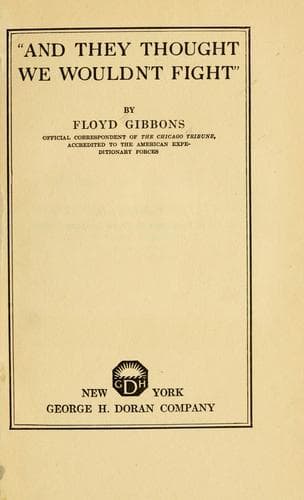
"And they thought we wouldn't fight"Gibbons, Floyd Phillips
History
"And they thought we wouldn't fight"
Gibbons, Floyd Phillips
World War, 1914-1918 -- Campaigns -- Western Front; World War, 1914-1918 -- Personal narratives
The Germans, unaware that a change had taken place in the personnel that
faced them, reeled back demoralised and unable to understand how such a
sudden show of resistance had been presented by the weakened French
troops which they had been driving before them for a week. The enemy's
advance had been made openly and confidently in the mistaken flush of
victory. Their triumphant advances of the previous week had more than
supported the statements of the German officers, who had told their men
that they were on the road to Paris--the end of the war and peace. It
was in this mood of victory that the enemy encountered the Marines'
stone wall and reeled back in surprise.
That engagement, in addition to lowering the enemy morale, deprived them
of their offensive spirit and placed them on the defensive. The next few
days were spent in advancing small strong points and the strengthening
of positions. In broad daylight one group of Marines rushed a German
machine gun pit in the open, killed or wounded every man in the crew,
disabled the gun and got back to their lines in safety.
It was at five o'clock on the bright afternoon of June 6th that the
United States Marines began to carve their way into history in the
battle of the Bois de Belleau. Major General Harbord, former Chief of
Staff to General Pershing, was in command of the Marine brigade. Orders
were received for a general advance on the brigade front. The main
objectives were the eastern edge of the Bois de Belleau and the towns of
Bussiares, Torcy and Bouresches.
Owing to the difficulty of liaison in the thickets of the wood, and
because of the almost impossible task of directing it in conjunction
with the advancing lines, the artillery preparation for the attack was
necessarily brief. At five o'clock to the dot the Marines moved out from
the woods in perfect order, and started across the wheat fields in four
long waves. It was a beautiful sight, these men of ours going across
those flat fields toward the tree clusters beyond from which the Germans
poured a murderous machine gun fire.
The woods were impregnated with nests of machine guns, but our advance
proved irresistible. Many of our men fell, but those that survived
pushed on through the woods, bayoneting right and left and firing as
they charged. So sweeping was the advance that in some places small
isolated units of our men found themselves with Germans both before and
behind them.
The enemy put up a stubborn resistance on the left, and it was not until
later in the evening that this part of the line reached the northeast
edge of the woods, after it had completely surrounded a most populous
machine gun nest which was located on a rocky hill. During the fighting
Colonel Catlin was wounded and Captain Laspierre, the French liaison
officer, was gassed, two casualties which represented a distinct blow to
the brigade, but did not hinder its further progress.
Public-domain text, read in full here on John Shaqi.
Reviews
Reviews
No reviews yet
Be the first to share your thoughts on this work.
Elsewhere in the archive
Join the Discussion
Join the discussion
Sign in to leave a comment or review.
Sign InorCreate an account