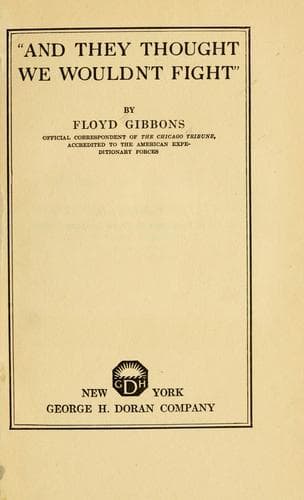
"And they thought we wouldn't fight"Gibbons, Floyd Phillips
History
"And they thought we wouldn't fight"
Gibbons, Floyd Phillips
World War, 1914-1918 -- Campaigns -- Western Front; World War, 1914-1918 -- Personal narratives
Since the days I read Hugo's chapters on the Battle of Waterloo in "Les
Miserables," I always considered as an ideal of fighting capacity and
the military spirit of sacrifice the old sergeant of Napoleon's Old
Guard. Hugo made me vividly see that old sergeant standing on a field
with a meagre remnant of the Old Guard gathered around him. Unable to
resist further, but unwilling to accept surrender, he and his followers
faced the British cannon. The British, respecting this admirable
demonstration of courage, ceased firing and called out to them, "Brave
Frenchmen, surrender."
The old sergeant, who was about to die, refused to accept this offer of
his life from the enemy. Into the very muzzles of the British cannon the
sergeant hurled back the offer of his life with one word. That word was
the vilest epithet in the French language. The cannons roared and the
old sergeant and his survivors died with the word on their lips. Hugo
wisely devoted an entire chapter to that single word.
But I have a new ideal to-day. I found it in the Bois de Belleau. A
small platoon line of Marines lay on their faces and bellies under the
trees at the edge of a wheat field. Two hundred yards across that flat
field the enemy was located in trees. I peered into the trees but could
see nothing, yet I knew that every leaf in the foliage screened scores
of German machine guns that swept the field with lead. The bullets
nipped the tops of the young wheat and ripped the bark from the trunks
of the trees three feet from the ground on which the Marines lay. The
minute for the Marine advance was approaching. An old gunnery sergeant
commanded the platoon in the absence of the lieutenant, who had been
shot and was out of the fight. This old sergeant was a Marine veteran.
His cheeks were bronzed with the wind and sun of the seven seas. The
service bar across his left breast showed that he had fought in the
Philippines, in Santo Domingo, at the walls of Pekin, and in the streets
of Vera Cruz. I make no apologies for his language. Even if Hugo were
not my precedent, I would make no apologies. To me his words were
classic, if not sacred.
As the minute for the advance arrived, he arose from the trees first and
jumped out onto the exposed edge of that field that ran with lead,
across which he and his men were to charge. Then he turned to give the
charge order to the men of his platoon--his mates--the men he loved. He
said:
"COME ON, YOU SONS-O'-BITCHES! DO YOU WANT TO LIVE FOREVER?"
CHAPTER XVI
WOUNDED--HOW IT FEELS TO BE SHOT
Just how does it feel to be shot on the field of battle? Just what is
the exact sensation when a bullet burns its way through your flesh or
crashes through your bones?
Public-domain text, read in full here on John Shaqi.
Reviews
Reviews
No reviews yet
Be the first to share your thoughts on this work.
Elsewhere in the archive
Join the Discussion
Join the discussion
Sign in to leave a comment or review.
Sign InorCreate an account