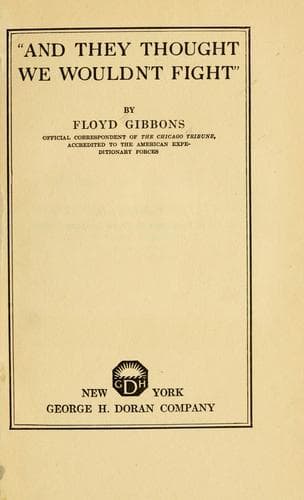
"And they thought we wouldn't fight"Gibbons, Floyd Phillips
History
"And they thought we wouldn't fight"
Gibbons, Floyd Phillips
World War, 1914-1918 -- Campaigns -- Western Front; World War, 1914-1918 -- Personal narratives
I always wanted to know. As a police reporter I "covered" scores of
shooting cases, but I could never learn from the victims what the
precise feeling was as the piece of lead struck. For long years I had
cherished an inordinate curiosity to know that sensation, if possible,
without experiencing it. I was curious and eager for enlightenment just
as I am still anxious to know how it is that some people willingly drink
buttermilk when it isn't compulsory.
I am still in the dark concerning the inexplicable taste for the sour,
clotted product of a sweet, well-meaning cow and the buttery, but I have
found out how it feels to be shot. I know it now by experience.
Three Germans bullets that violated my person left me as many scars and
at the same time completely satisfied my curiosity. I think now if I can
ever muster up enough courage to drink a glass of buttermilk, I shall
have bereft myself of my last inquisitiveness.
It happened on June 6th just to the northwest of Chateau-Thierry in the
Bois de Belleau. On the morning of that day I left Paris by motor for a
rush to the front. The Germans were on that day within forty miles of
the capital of France. On the night before, the citizens of Paris, in
their homes and hotels, had heard the roll of the guns drawing ever
nearer. Many had left the city.
But American divisions were in the line between the enemy and their
goal, and the operation of these divisions was my object in hustling to
the front. On the broad, paved highway from Paris to Meaux, my car
passed miles and miles of loaded motor trucks bound frontward. Long
lines of these carried thousands of Americans. Other long lines were
loaded down with shells and cartridge boxes. On the right side of the
road, bound for Paris and points back of the line, was an endless stream
of ambulances and other motor trucks bringing back wounded. Dense clouds
of dust hung like a pall over the length of the road. The day was hot,
the dust was stifling.
From Meaux we proceeded along the straight highway that borders the
south banks of the Marne to LaFerte, at which place we crossed the river
and turned north to Montreuil, which was the newly occupied headquarters
of the Second United States Army Division, General Omar Bundy
commanding. On the day before, the two infantry brigades of that
division, one composed of the 5th and 6th U. S. Marines, under command
of Brigadier General Harbord, the other composed of the 9th and 23rd U.
S. Infantry, had been thrown into the line which was just four miles to
the north and east.
Public-domain text, read in full here on John Shaqi.
Reviews
Reviews
No reviews yet
Be the first to share your thoughts on this work.
Elsewhere in the archive
Join the Discussion
Join the discussion
Sign in to leave a comment or review.
Sign InorCreate an account