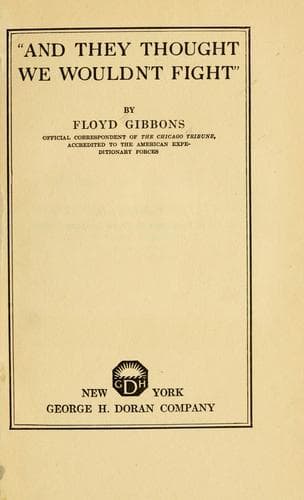
"And they thought we wouldn't fight"Gibbons, Floyd Phillips
History
"And they thought we wouldn't fight"
Gibbons, Floyd Phillips
World War, 1914-1918 -- Campaigns -- Western Front; World War, 1914-1918 -- Personal narratives
The fight had been hot during the morning. The Marines on the left flank
of the divisional sector had been pushing their lines forward through
triangle woods and the village of Lucy-le-Bocage. The information of
their advances was given to me by the Divisional Intelligence officer,
who occupied a large room in the rear of the building that was used as
Divisional Headquarters. The building was the village _Mairie_, which
also included the village school-house. Now the desks of the school
children were being used by our staff officers and the walls and
blackboards were covered with maps.
I was accompanied by Lieutenant Oscar Hartzell, formerly of the _New
York Times_ staff. We learned that orders from the French High Command
called for a continuation of the Marine advance during the afternoon and
evening, and this information made it possible for us to make our plans.
Although the Germans were shelling roads immediately behind the front,
Lieutenant Hartzell and I agreed to proceed by motor from Montreuil a
mile or so to a place called La Voie du Chatel, which was the
headquarters of Colonel Neveille of the 5th Marines. Reaching that place
around four o'clock, we turned a despatch over to the driver of our
staff car with instructions that he proceed with all haste to Paris and
there submit it to the U. S. Press Bureau.
Lieutenant Hartzell and I announced our intentions of proceeding at once
to the front line to Colonel Neveille.
"Go wherever you like," said the regimental commander, looking up from
the outspread maps on the kitchen table in the low-ceilinged stone
farm-house that he had adopted as headquarters. "Go as far as you like,
but I want to tell you it's damn hot up there."
An hour later found us in the woods to the west of the village of Lucy
le Bocage, in which German shells were continually falling. To the west
and north another nameless cluster of farm dwellings was in flames. Huge
clouds of smoke rolled up like a smudge against the background of blue
sky.
The ground under the trees in the wood was covered with small bits of
white paper. I could not account for their presence until I examined
several of them and found that these were letters from American mothers
and wives and sweethearts--letters--whole packages of them, which the
tired, dog-weary Marines had been forced to remove from their packs and
destroy in order to ease the straps that cut into aching grooves in
their shoulders. Circumstances also forced the abandonment of much other
material and equipment.
Occasional shells were dropping in the woods, which were also within
range from a long distance, indirect machine gun fire from the enemy.
Bits of lead, wobbling in their flight at the end of their long
trajectory, sung through the air above our heads and clipped leaves and
twigs from the branches. On the edge of the woods we came upon a hastily
dug out pit in which there were two American machine guns and their
crews.
Public-domain text, read in full here on John Shaqi.
Reviews
Reviews
No reviews yet
Be the first to share your thoughts on this work.
Elsewhere in the archive
Join the Discussion
Join the discussion
Sign in to leave a comment or review.
Sign InorCreate an account