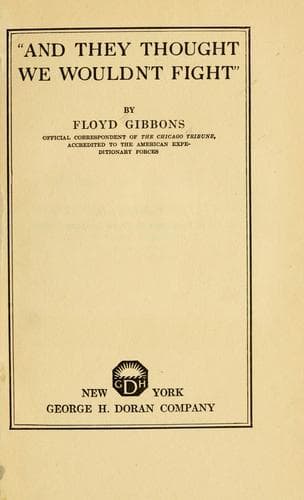
"And they thought we wouldn't fight"Gibbons, Floyd Phillips
History
"And they thought we wouldn't fight"
Gibbons, Floyd Phillips
World War, 1914-1918 -- Campaigns -- Western Front; World War, 1914-1918 -- Personal narratives
I remembered my French gas mask hanging from my shoulder and recalled
immediately that it was much flatter, being hardly half an inch in
thickness. I forthwith drew up the French mask to my head, extracted the
British one and rested my cheek closer to the ground on the French one.
Thus, I lowered my head about an inch and a half--an inch and a half
that represented worlds of satisfaction and some optimism to me.
Sometimes there were lulls in the firing. During those periods of
comparative quiet, I could hear the occasional moan of other wounded on
that field. Very few of them cried out and it seemed to me that those
who did were unconscious when they did it. One man in particular had a
long, low groan. I could not see him, yet I felt he was lying somewhere
close to me. In the quiet intervals, his unconscious expression of pain
reminded me of the sound I had once heard made by a calf which had been
tied by a short rope to a tree. The animal had strayed round and round
the tree until its entanglements in the rope had left it a helpless
prisoner. The groan of that unseen, unconscious wounded American who
laid near me on the field that evening sounded exactly like the pitiful
bawl of that calf.
Those three hours were long in passing. With the successive volleys that
swept the field, I sometimes lost hope that I could ever survive it. It
seemed to me that if three German bullets had found me within the space
of fifteen minutes, I could hardly expect to spend three hours without
receiving the fatal one. With such thoughts on my mind I reopened
conversation with Hartzell.
"How's it coming, old man?" I shouted.
"They're coming damn close," he said; "how is it with you? Are you
losing much blood?"
"No, I'm all right as far as that goes," I replied, "but I want you to
communicate with my wife, if its 'west' for me."
"What's her address?" said Hartzell.
"It's a long one," I said. "Are you ready to take it?"
"Shoot," said Hartzell.
"'Mrs. Floyd Gibbons, No. 12 Bis, Rue de la Chevalier de la Barre,
Dijon, Cote d'Or, France.'" I said slowly.
"My God," said Hartzell, "say it again."
Back and forth we repeated the address correctly and incorrectly some
ten or twelve times until Hartzell informed me that he knew it well
enough to sing it. He also gave me his wife's address. Then just to make
conversation he would shout over, every fifteen minutes, and tell me
that there was just that much less time that we would have to lie there.
I thought that hour between seven and eight o'clock dragged the most,
but the one between eight and nine seemed interminable. The hours were
so long, particularly when we considered that a German machine gun could
fire three hundred shots a minute. Dusk approached slowly. And finally
Hartzell called over:
"I don't think they can see us now," he said; "let's start to crawl
back."
"Which way shall we crawl?" I asked.
"Into the woods," said Hartzell.
"Which woods?" I asked.
Public-domain text, read in full here on John Shaqi.
Reviews
Reviews
No reviews yet
Be the first to share your thoughts on this work.
Elsewhere in the archive
Join the Discussion
Join the discussion
Sign in to leave a comment or review.
Sign InorCreate an account