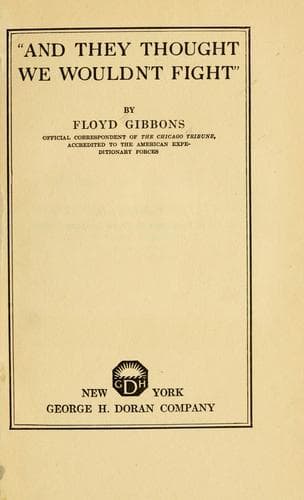
"And they thought we wouldn't fight"Gibbons, Floyd Phillips
History
"And they thought we wouldn't fight"
Gibbons, Floyd Phillips
World War, 1914-1918 -- Campaigns -- Western Front; World War, 1914-1918 -- Personal narratives
"The woods we came out of, you damn fool," he replied.
"Which direction are they in?" I said, "I've been moving around and I
don't know which way I am heading. Are you on my left, or on my right?"
"I can't tell whether I'm on your left or your right," he replied. "How
are you lying, on your face or on your back?"
"On my face," I said, "and your voice sounds like it comes from in back
of me and on the left."
"If that's the case," said Hartzell, "your head is lying toward the
wrong woods. Work around in a half circle and you'll be facing the right
direction."
I did so and then heard Hartzell's voice on my right. I started moving
toward him. Against my better judgment and expressed wishes, he crawled
out toward me and met me half way. His voice close in front of me
surprised me.
"Hold your head up a little," he said, "I want to see where it hit you."
"I don't think it looks very nice," I replied, lifting my head. I wanted
to know how it looked myself, so I painfully opened the right eye and
looked through the oats eighteen inches into Hartzell's face. I saw the
look of horror on it as he looked into mine.
Twenty minutes later, after crawling painfully through the interminable
yards of young oats, we reached the edge of the woods and safety.
That's how it feels to be shot.
CHAPTER XVII
"GOOD MORNING, NURSE"
Weakness from the loss of blood began to grow on me as Lieutenant
Hartzell and I made our way through the deepening shadows of the wooded
hillside in the rear of the field on which I had been shot. In an
upright position of walking the pains in my head seemed to increase. We
stopped for a minute and, neither of us having first aid kits with us, I
resurrected a somewhat soiled silk handkerchief with which Hartzell
bound up my head in a manner that applied supporting pressure over my
left eye and brought a degree of relief.
Hartzell told me later that I was staggering slightly when we reached a
small relief dugout about a mile back of the wood. There a medical corps
man removed the handkerchief and bound my head with a white gauze
bandage. I was anxious to have the wound cleaned but he told me there
was no water. He said they had been forced to turn it over to the men to
drink. This seemed to me to be as it should be because my thirst was
terrific, yet there was no water left.
We stumbled rearward another half mile and, in the darkness, came upon
the edge of another wooded area. A considerable number of our wounded
were lying on stretchers on the ground. The Germans were keeping up a
continual fire of shrapnel and high explosive shell in the woods,
apparently to prevent the mobilisation of reserves, but the doctors,
taking care of the wounded, proceeded with their work without notice to
the whine of the shells passing overhead or the bursting of those that
landed nearby. They went at their work just as though they were caring
for injured men on a football field.
Public-domain text, read in full here on John Shaqi.
Reviews
Reviews
No reviews yet
Be the first to share your thoughts on this work.
Elsewhere in the archive
Join the Discussion
Join the discussion
Sign in to leave a comment or review.
Sign InorCreate an account