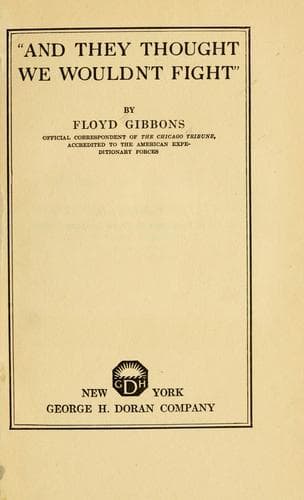
"And they thought we wouldn't fight"Gibbons, Floyd Phillips
History
"And they thought we wouldn't fight"
Gibbons, Floyd Phillips
World War, 1914-1918 -- Campaigns -- Western Front; World War, 1914-1918 -- Personal narratives
Hartzell stretched me out on the ground and soon had a doctor bending
over me. The doctor removed the eye bandage, took one look at what was
beneath it and then replaced it. I remember this distinctly because at
the time I made the mental note that the doctor apparently considered my
head wound beyond anything he could repair. He next turned his attention
to my arm and shoulder. He inserted his scissors into my left sleeve at
the wrist and ripped it up to the shoulder. He followed this operation
by cutting through my heavy khaki tunic from the shoulder to the collar.
A few more snips of the nickel-plated blades and my shirt and undershirt
were cut away. He located the three bullet holes, two in the arm and one
across the top of the shoulder, and bound them up with bandages.
"We're awful shy on ambulances," he said; "you will have to lie here a
while."
"I feel that I can walk all right if there is no reason why I
shouldn't," I replied.
"You ought to be in an ambulance," said the doctor, "but if you feel
that you can make it, you might take a try at it."
Then turning to Lieutenant Hartzell, he said, "Keep right with him, and
if he begins to get groggy, make him lie down."
So Hartzell and I resumed our rearward plodding or staggering. He walked
at my right side and slightly in front of me, holding my right arm over
his right shoulder and thereby giving me considerable support. We had
not proceeded far before we heard the racing motor of an automobile
coming from behind us. An occasional shell was dropping along the road
we were now on.
A stick struck my legs from behind in the darkness. And then an
apologetic voice said:
"Beg your pardon, sir, just feeling along the road for shell holes.
Ambulance right behind me, sir. Would you mind stepping to one side?
Come on, Bill," to the driver of the ambulance, "it looks all clear
through here."
The automobile with the racing motor turned out to be a light ambulance
of a popular Detroit make. Its speeding engine was pure camouflage for
its slow progress. It bubbled and steamed at the radiator cap as it
pushed along at almost a snail's pace.
"All full?" Hartzell shouted into the darkness of the driver's seat.
"To the brim," responded the driver. "Are you wounded?"
"No, but I have a wounded man with me," said Hartzell. "He can sit
beside you on the seat if you have room."
"Get right in," said the driver, and Hartzell boosted me into the front
seat. We pushed along slowly, Hartzell walking beside the car and the
driver's assistant proceeding ahead of us, searching the dark road with
his cane for new shell craters.
Occasionally, when our wheels would strike in one of these, groans would
come from the ambulance proper.
"Take it easy," would come a voice through pain-pressed lips; "for
Christ's sake, do you think you are driving a truck?"
Public-domain text, read in full here on John Shaqi.
Reviews
Reviews
No reviews yet
Be the first to share your thoughts on this work.
Elsewhere in the archive
Join the Discussion
Join the discussion
Sign in to leave a comment or review.
Sign InorCreate an account