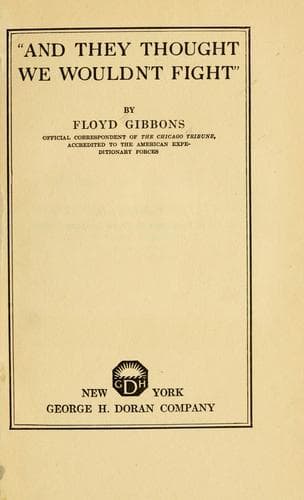
"And they thought we wouldn't fight"Gibbons, Floyd Phillips
History
"And they thought we wouldn't fight"
Gibbons, Floyd Phillips
World War, 1914-1918 -- Campaigns -- Western Front; World War, 1914-1918 -- Personal narratives
Sometime during the dark hours of the early morning we stopped in the
courtyard of a hospital and I was taken into another examination room
illuminated with painfully brilliant lights. I was placed on a table for
an examination, which seemed rather hurried, and then the table was
rolled away some distance down a corridor. I never understood that move
until some weeks later when a Lieutenant medical officer told me that it
was he who had examined me at that place.
"You're looking pretty fit, now," he said, "but that night when I saw
you I ticketed you for the dead pile. You didn't look like you could
live till morning."
His statement gave me some satisfaction. There is always joy in fooling
the doctor.
Hartzell, who still accompanied me, apparently rescued me from the "dead
pile" and we started on another motor trip, this time on a stretcher in
a large, easier-riding ambulance. In this I arrived shortly after dawn
at the United States Military Base Hospital at Neuilly-sur-Seine, on the
outskirts of Paris.
There were more hurried examinations and soon I was rolled down a
corridor on a wheeled table, into an elevator that started upward. Then
the wheeled table raced down another long corridor and I began to feel
that my journeyings were endless. We stopped finally in a room where I
distinctly caught the odour of ether. Some one began removing my boots
and clothes. As that some one worked he talked to me.
"I know you, Mr. Gibbons," he said. "I'm from Chicago also. I am
Sergeant Stephen Hayes. I used to go to Hyde Park High School. We're
going to fix you up right away."
I learned from Hayes that I was lying in a room adjoining the operating
chamber and was being prepared for the operating table. Some information
concerning the extent of my injuries and the purpose of the operation
would have been comforting and would have relieved the sensation of
utter helpless childishness that I was experiencing.
I knew I was about to go under the influence of the anesthetic and that
something was going to be done to me. I had every confidence that
whatever was done would be for the best but it was perfectly natural
that I should be curious about it. Was the operation to be a serious one
or a minor one? Would they have to remove my eye? Would they have to
operate on my skull? How about the arm? Would there be an amputation?
How about the other eye? Would I ever see again? It must be remembered
that in spite of all the examinations I had not been informed and
consequently had no knowledge concerning the extent of my injuries. The
only information I had received had been included in vague remarks
intended as soothing, such as "You're all right, old man." "You'll pull
through fine." "You're coming along nicely." But all of it had seemed
too professionally optimistic to satisfy me and my doubts still
remained.
Public-domain text, read in full here on John Shaqi.
Reviews
Reviews
No reviews yet
Be the first to share your thoughts on this work.
Elsewhere in the archive
Join the Discussion
Join the discussion
Sign in to leave a comment or review.
Sign InorCreate an account