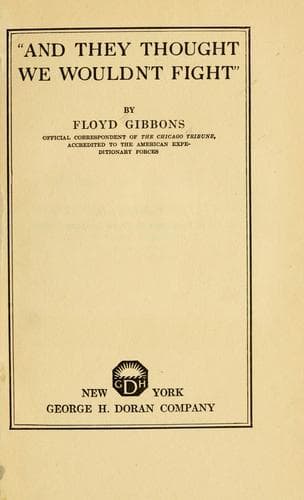
"And they thought we wouldn't fight"Gibbons, Floyd Phillips
History
"And they thought we wouldn't fight"
Gibbons, Floyd Phillips
World War, 1914-1918 -- Campaigns -- Western Front; World War, 1914-1918 -- Personal narratives
They were relieved, however, by the pressure of a hand and the sound of
a voice. In the words spoken and in the pressure of the hand, there was
hardly anything different from similar hand pressures and similar spoken
phrases that had come to me during the night, yet there was everything
different. This voice and this hand carried supreme confidence. I could
believe in both of them. I felt the hand pressure on my right shoulder
and the mild kindly voice said:
"Son, I am going to operate on you. I have examined you and you are all
right. You are going to come through fine. Don't worry about anything."
"Thank you, very much," I said, "I like your voice. It sounds like my
father's. Will you tell me your name?"
"I am Major Powers," the kindly voice said. "Now just take it easy, and
I will talk to you again in a couple of hours when you feel better."
The speaker, as I learned later, was Major Charles Powers, of Denver,
Colorado, one of the best-known and best-loved surgeons in the West. A
man far advanced in his profession and well advanced in his years, a man
whose life has not been one of continual health, a man who, upon
America's entry of the war, sacrificed the safety of the beneficial air
rarity of his native Denver to answer the country's call, to go to
France at great personal risk to his health--a risk only appreciated by
those who know him well. It was Major Powers who operated upon the
compound fracture in my skull that morning.
My mental note-taking continued as the anesthetist worked over me with
the ether. As I began breathing the fumes I remember that my senses were
keenly making observations on every sensation I experienced. The thought
even went through my mind that it would be rather an unusual thing to
report completely the impressions of coma. This suggestion became a
determination and I became keyed up to everything going on about me.
The conversation of the young doctor who was administering the
anesthetic interested me unusually. He was very busy and business-like
and although I considered myself an important and most interested party
in the entire proceedings, his conversation ignored me entirely. He not
only did not talk to me, but he was not even talking about me. As he
continued to apply the ether, he kept up a running fire of entirely
extraneous remarks with some other person near the table. I did not
appreciate then, as I do now, that I was only one of very, very many
that he had anesthetised that morning and the night before, but at the
time his seeming lack of all interest in me as me, piqued me
considerably.
Public-domain text, read in full here on John Shaqi.
Reviews
Reviews
No reviews yet
Be the first to share your thoughts on this work.
Elsewhere in the archive
Join the Discussion
Join the discussion
Sign in to leave a comment or review.
Sign InorCreate an account