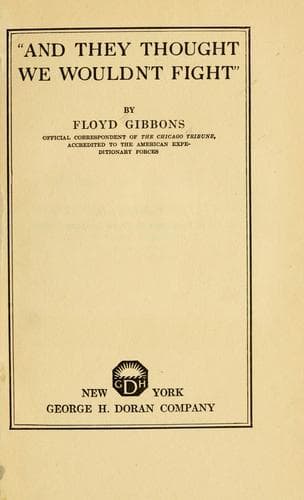
"And they thought we wouldn't fight"Gibbons, Floyd Phillips
History
"And they thought we wouldn't fight"
Gibbons, Floyd Phillips
World War, 1914-1918 -- Campaigns -- Western Front; World War, 1914-1918 -- Personal narratives
"All of you guys have told what you're going to do," he said, "now I'm
going to tell you the truth. I'm going back to that little town of mine
in Ohio and go down to the grocery store and sit there on a soap box on
the porch.
"Then I'm going to gather all the little boys in the neighbourhood round
about me and then I'm going to outlie the G. A. R."
There was one thing in that ward that nobody could lie about and that
was the twitches of pain we suffered in the mornings when the old
dressings of the day before were changed and new ones applied.
The doctor and his woman assistant who had charge of the surgical
dressings on that corridor would arrive in the ward shortly after
breakfast. They would be wheeling in front of them a rubber-tired,
white-enamelled vehicle on which were piled the jars of antiseptic
gauze and trays of nickel-plated instruments, which both the doctor and
his assistant would handle with rubber-gloved hands. In our ward that
vehicle was known as the "Agony Cart," and every time it stopped at the
foot of a bed you would be pretty sure to hear a groan or a stifled wail
in a few minutes.
We had various ways of expressing or suppressing the pain. You who have
had a particularly vicious mustard plaster jerked off that tender spot
in the back, right between the shoulders, have some small conception of
the delicate sensation that accompanies the removal of old gauze from a
healing wound.
Some of the men would grit their teeth and grunt, others would put their
wrists in their mouths and bite themselves during the operation. Some
others would try to keep talking to the doctor or the nurse while the
ordeal was in progress and others would just simply shout. There was
little satisfaction to be gained from these expressions of pain because
while one man was yelling the other thirteen in the ward were shouting
with glee and chaffing him, and as soon as his wounds had been redressed
he would join in the laughs at the expense of those who followed him.
There was a Jewish boy in the ward and he had a particularly painful
shell wound in his right leg. He was plucky about the painful treatment
and used to say to the doctor, "Don't mind me yelling, doc. I can't help
it, but you just keep right on."
The Jew boy's cry of pain as near as I can reproduce it went something
like this, "Oy! Oy!! Oy!!! YOY!!! Doctor!"
The Jew boy's clear-toned enunciation of this Yiddish lullaby, as the
rest of the ward called it, brought many a heartless, fiendish laugh
from the occupants of the other beds. We almost lost one of our
patients on account of that laugh. He nearly laughed himself to
death--in fact.
Public-domain text, read in full here on John Shaqi.
Reviews
Reviews
No reviews yet
Be the first to share your thoughts on this work.
Elsewhere in the archive
Join the Discussion
Join the discussion
Sign in to leave a comment or review.
Sign InorCreate an account