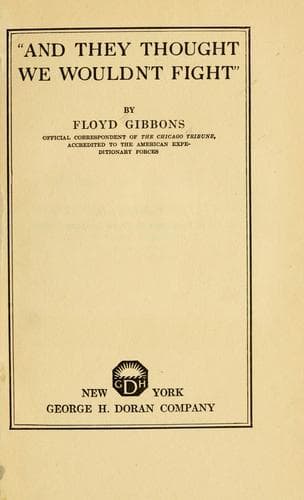
"And they thought we wouldn't fight"Gibbons, Floyd Phillips
History
"And they thought we wouldn't fight"
Gibbons, Floyd Phillips
World War, 1914-1918 -- Campaigns -- Western Front; World War, 1914-1918 -- Personal narratives
This near victim of uncontrollable risibilities was an Italian boy from
the East Side of New York. A piece of shrapnel had penetrated one of his
lungs and pleurisy had developed in the other one. It had become
necessary to operate on one of the lungs and tape it down. The boy had
to do his best to breathe with one lung that was affected by pleurisy.
Every breath was like the stab of a knife and it was quite natural that
the patient would be peevish and garrulous. The whole ward called him
the "dying Wop." But his name was Frank.
When the Jew boy would run the scale with his torture cry, the "dying
Wop" would be forced to forget his laboured breathing and give vent to
laughter. These almost fatal laughs sounded something like this:
"He! Hee!! Hee!!! (on a rising inflection and then much softer) Oh, Oh,
Oh! Stop him, stop him, stop him!" The "He-Hee's" were laughs, but the
"Oh-oh's" were excruciating pain.
Frank grew steadily worse and had to be removed from the ward. Weeks
afterward I went back to see him and found him much thinner and
considerably weaker. He occupied a bed on one of the pavilions in the
garden. He was still breathing out of that one lung and between gasps he
told me that six men had died in the bed next to him. Then he smiled up
at me with a look in his eyes that seemed to say, "But they haven't
croaked the 'dying Wop' yet."
"This here--hospital stuff----" Frank told me slowly, and between gasps,
"is the big fight after all. I know--I am fighting here--against
death--and am going to win out, too.
"I'm going to win out even though it is harder to fight--than
fighting--the Germans--up front. We Italians licked Hell out of them--a
million years ago. Old General Caesar did it and he used to bring them
back to Rome and put 'em in white-wing suits on the streets."
For all his quaint knowledge of Caesar's successes against the
progenitors of Kulturland of to-day, Frank was all American. Here was a
rough-cut young American from the streets of New York's Little Italy.
Here was a man who had almost made the supreme sacrifice. Here was a man
who, if he did escape death, faced long weakened years ahead. It
occurred to me that I would like to know, that it would be interesting
to know, in what opinion this wounded American soldier, the son of
uneducated immigrant parents, would hold the Chief Executive of the
United States, the man he would most likely personify as responsible for
the events that led up to his being wounded on the battlefield.
"Frank," I asked, "what do you think about the President of the United
States?"
Public-domain text, read in full here on John Shaqi.
Reviews
Reviews
No reviews yet
Be the first to share your thoughts on this work.
Elsewhere in the archive
Join the Discussion
Join the discussion
Sign in to leave a comment or review.
Sign InorCreate an account