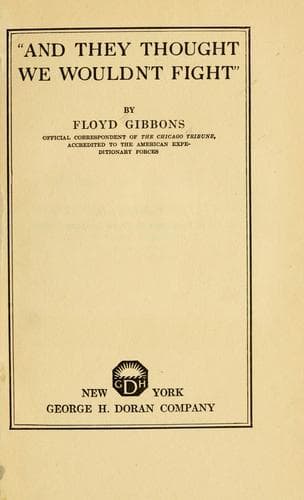
"And they thought we wouldn't fight"Gibbons, Floyd Phillips
History
"And they thought we wouldn't fight"
Gibbons, Floyd Phillips
World War, 1914-1918 -- Campaigns -- Western Front; World War, 1914-1918 -- Personal narratives
Big Boy would smile up to her a look which she would accept and
interpret as one of deep, undying gratitude. The kindly-intentioned one
surrounding herself with that benediction that is derived from a sacred
duty well performed, would walk slowly from the room and as the door
would close behind her, Big Boy's gruff drawling voice would sing out in
a call for the orderly.
"Dan, remove the funeral decorations," he would order.
Dan Sullivan, our orderly, was the busiest man in the hospital. Big Boy
liked to smoke, but, being paralysed, he required assistance. At regular
intervals during the day the ward room door, which was close to Big
Boy's bed, would open slowly and through the gap four or six inches wide
the rest of the ward would get a glimpse of Dan standing in the opening
with his arms piled high with pots and utensils, and a cigarette hanging
from the corner of his mouth.
[Illustration: THE NEWS FROM THE STATES]
[Illustration: SMILING WOUNDED AMERICAN SOLDIERS]
With one hand he would extract the cigarette, insert hand and arm
through the opening in the door until it hovered above Big Boy's face.
Then the hand would descend and the cigarette would be inserted in Big
Boy's mouth just as you would stick a pin in a pin-cushion. Big Boy
would lie back comfortably and puff away like a Mississippi steamboat
for four or five minutes and then the door would open just a crack
again, the mysterious hand and arm would reach in once more and the
cigarette would be plucked out. That was the way Big Boy got his
"smokes."
If Big Boy's voice was gruff, there was still a gruffer voice that used
to come from a man in the corner of the ward to the left of my bed.
During the first four or five days I was an inmate of the ward, I was
most interested in all the voices I heard because I lay in total
darkness. The bandages extended down from the top of my head to my upper
lip, and I did not know whether or not I ever would see again. I would
listen carefully to all remarks within ear-shot, whether they be from
doctors, nurses or patients. I listened in the hope that from them I
might learn whether or not there was a possibility of my regaining
vision. But all of their remarks with regard to my condition were
ambiguous and unsatisfactory. But from this I gained a listening habit
and that was how I became particularly interested in the very gruff
voice that came from the corner on my left.
Other patients directing remarks into that corner would address them to
a man whom they would call by name "Red Shannahan." I was quick to
connect the gruff voice and the name "Red Shannahan," and as I had lots
of time and nothing else to do, I built up in my mind's eye a picture of
a tall, husky, rough and ready, tough Irishman, with red hair--a man of
whom it would be conceivable that he had wiped out some two or three
German regiments before they got him. To find out more about this
character, I called over to him one day.
"Red Shannahan, are you there?" I said.
Public-domain text, read in full here on John Shaqi.
Reviews
Reviews
No reviews yet
Be the first to share your thoughts on this work.
Elsewhere in the archive
Join the Discussion
Join the discussion
Sign in to leave a comment or review.
Sign InorCreate an account