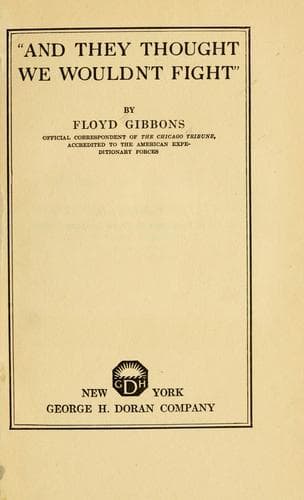
"And they thought we wouldn't fight"Gibbons, Floyd Phillips
History
"And they thought we wouldn't fight"
Gibbons, Floyd Phillips
World War, 1914-1918 -- Campaigns -- Western Front; World War, 1914-1918 -- Personal narratives
He seemed to be considering for a minute, or maybe he was only waiting
to gather sufficient breath to make an answer. He had been lying with
his eyes directed steadfastly toward the ceiling. Now he turned his face
slowly toward me. His eyes, sunken slightly in their sockets, shone
feverishly. His pinched, hollow cheeks were still swarthy, but the
background of the white pillow made them look wan. Slowly he moistened
his lips, and then he said:
"Say--say--that guy--that guy's--got hair--on his chest."
That was the opinion of the "dying Wop."
After Frank's removal from our ward, the rest of us frequently sent
messages of cheer down to him. These messages were usually carried by a
young American woman who had a particular interest in our ward. Not
strange to say, she had donned a Red Cross nursing uniform on the same
day that most of us arrived in that ward. She was one of the American
women who brought us fruit, ice cream, candy and cigarettes. She wrote
letters for us to our mothers. She worked long hours, night and day, for
us. In her absence, one day, the ward went into session and voted her
its guardian angel. Out of modesty, I was forced to answer "Present"
instead of "Aye" to the roll-call. The Angel was and is my wife.
As Official Ward Angel it was among the wife's duties to handle the
matter of visitors, of which there were many. It seemed, during those
early days in June, that every American woman in France dropped whatever
war work she was doing and rushed to the American hospitals to be of
whatever service she could. And it was not easy work these women
accomplished. There was very little "forehead-rubbing" or "moving
picture nursing." Much of it was tile corridor scrubbing and pan
cleaning. They stopped at no tasks they were called upon to perform.
Many of them worked themselves sick during the long hours of that rush
period.
Sometimes the willingness, eagerness and sympathy of some of the
visitors produced humourous little incidents in our hospital life.
Nearly all of the women entering our ward would stop at the foot of "Big
Boy's" bed. They would learn of his paralysed condition from the chart
attached to the foot of the bed. Then they would mournfully shake their
heads and slowly pronounce the words "Poor boy."
And above all things in the world distasteful to Big Boy was that one
expression "Poor boy" because as soon as the kindly intentioned women
would leave the room, the rest of the ward would take up the "Poor boy"
chorus until Big Boy got sick of it. Usually, however, before leaving
the ward the woman visitor would take from a cluster of flowers on her
arm, one large red rose and this she would solemnly deposit on Big Boy's
defenceless chest.
Public-domain text, read in full here on John Shaqi.
Reviews
Reviews
No reviews yet
Be the first to share your thoughts on this work.
Elsewhere in the archive
Join the Discussion
Join the discussion
Sign in to leave a comment or review.
Sign InorCreate an account