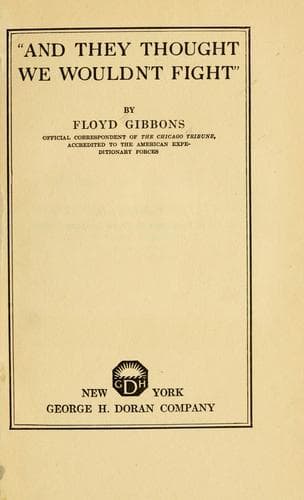
"And they thought we wouldn't fight"Gibbons, Floyd Phillips
History
"And they thought we wouldn't fight"
Gibbons, Floyd Phillips
World War, 1914-1918 -- Campaigns -- Western Front; World War, 1914-1918 -- Personal narratives
Slightly wounded Americans came back guarding convoys of prisoners. They
returned loaded with relics of the fighting. It was said that day that
German prisoners had explained that in their opinion, the British were
in the war because they hated Germany and that the French were in the
war because the war was in France, but that Americans seemed to be
fighting to collect souveniers.
I saw one of these American souvenier collectors bound for the rear. In
stature he was one of the shortest men I had ever seen in our uniform.
He must have spent long years in the cavalry, because he was frightfully
bowlegged. He was herding in front of him two enormous German prisoners
who towered head and shoulders above him.
He manifested a confidence in his knowledge of all prisoners and things
German. Germans were "foreigners." "Foreigners" spoke a foreign
language. Therefore to make a German understand you, it was only
necessary to speak with them in a foreign language. French was a foreign
language so the bowlegged American guard made use of his limited
knowledge.
"Allay! Allay! Allay veet t'ell outer here," he urged his charges.
He was wearing his helmet back on his head so that there was exposed a
shock of black, blood-matted hair on his forehead. A white bandage ran
around his forehead and on the right side of his face a strip of cotton
gauze connected with another white bandage around his neck. There was a
red stain on the white gauze over the right cheek.
His face was rinsed with sweat and very dirty. In one hand he carried a
large chunk of the black German war bread--once the property of his two
prisoners. With his disengaged hand he conveyed masses of the food to
his lips which were circled with a fresco of crumbs.
His face was wreathed in a remarkable smile--a smile of satisfaction
that caused the corners of his mouth to turn upward toward his eyes. I
also smiled when I made a casual inventory of the battlefield loot with
which he had decorated his person. Dangling by straps from his right hip
were five holsters containing as many German automatic pistols of the
Lueger make, worth about $35 apiece. Suspended from his right shoulder
by straps to his left hip, were six pairs of highly prized German field
glasses, worth about $100 apiece. I acquired a better understanding of
his contagious smile of property possession when I inquired his name and
his rank. He replied:
"Sergeant Harry Silverstein."
Later, attracted by a blast of extraordinary profanity, I approached one
of our men who was seated by the roadside. A bullet had left a red
crease across his cheek but this was not what had stopped him. The
hobnail sole of his shoe had been torn off and he was trying to fasten
it back on with a combination of straps. His profane denunciations
included the U. S. Quartermaster Department, French roads, barbed wire,
hot weather and, occasionally, the Germans.
Public-domain text, read in full here on John Shaqi.
Reviews
Reviews
No reviews yet
Be the first to share your thoughts on this work.
Elsewhere in the archive
Join the Discussion
Join the discussion
Sign in to leave a comment or review.
Sign InorCreate an account