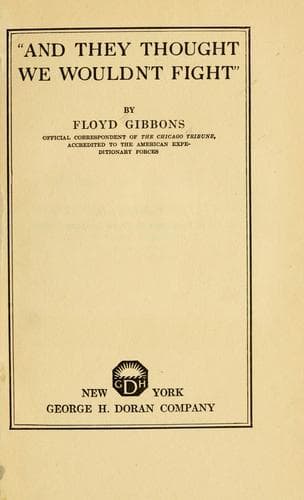
"And they thought we wouldn't fight"Gibbons, Floyd Phillips
History
"And they thought we wouldn't fight"
Gibbons, Floyd Phillips
World War, 1914-1918 -- Campaigns -- Western Front; World War, 1914-1918 -- Personal narratives
"This sure is a hell of a mess," he said, "for a fellow to find himself
in this fix just when I was beginning to catch sight of 'em. I enlisted
in the army to come to France to kill Germans but I never thought for
one minute they'd bring me over here and try to make me run 'em to
death. What we need is greyhounds. And as usual the Q. M. fell down
again. Why, there wasn't a lassoe in our whole company."
* * * * *
The prisoners came back so fast that the Intelligence Department was
flooded. The divisional intelligence officer asked me to assist in the
interrogation of the captives. I questioned some three hundred of them.
An American sergeant who spoke excellent German, interrogated. I sat
behind a small table in a field and the sergeant would call the
prisoners forward one by one. In German he asked one captive what branch
of the service he belonged to. The prisoner wishing to display his
knowledge of English and at the same time give vent to some pride,
replied in English.
"I am of the storm troop," he said.
"Storm troop?" replied the American sergeant, "do you know what we are?
We are from Kansas. We are Cycloners."
Another German student of English among the prisoners was represented in
the person of a pompous German major, who, in spite of being a captive,
maintained all the dignity of his rank. He stood proudly erect and held
his head high. He wore a disgusted look on his face, as though the
surroundings were painful. His uniform was well pressed, his linen was
clean, his boots were well polished, he was clean shaven. There was not
a speck of dust upon him and he did not look like a man who had gone
through the hell of battle that morning. The American sergeant asked him
in German to place the contents of his pockets on the table.
"I understand English," he replied superciliously, with a strong accent,
as he complied with the request. I noticed, however, that he neglected
to divest himself of one certain thing that caught my interest. It was a
leather thong that extended around his neck and disappeared between the
first and second buttons of his tunic. Curiosity forced me to reach
across the table and extract the hidden terminal of that thong. I found
suspended on it the one thing in all the world that exactly fitted me
and that I wanted. It was a one-eyed field glass. I thanked him.
He told me that he had once been an interne in a hospital in New York
but happening to be in Germany at the outbreak of the war, he had
immediately entered the army and had risen to the rank of a major in the
Medical Corps. I was anxious for his opinion, obvious as it might have
seemed.
"What do you think of the fighting capacity of the American soldier?" I
asked him.
"I do not know," he replied in the accented but dignified tones of a
superior who painfully finds himself in the hands of one considered
inferior. "I have never seen him fight. He is persuasive--yes.
Public-domain text, read in full here on John Shaqi.
Reviews
Reviews
No reviews yet
Be the first to share your thoughts on this work.
Elsewhere in the archive
Join the Discussion
Join the discussion
Sign in to leave a comment or review.
Sign InorCreate an account