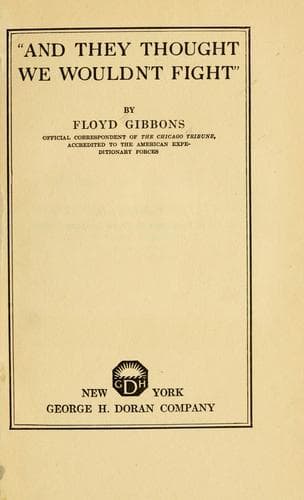
"And they thought we wouldn't fight"Gibbons, Floyd Phillips
History
"And they thought we wouldn't fight"
Gibbons, Floyd Phillips
World War, 1914-1918 -- Campaigns -- Western Front; World War, 1914-1918 -- Personal narratives
"More of us are coming," was the keynote of his modest remarks.
Afterward he was escorted to the quay-side station, where a special
train of the type labelled Semi-Royal was ready to make the express run
to London.
The reception at the dock had had none of the features of a
demonstration by reason of the necessity for the ship's arrival being
secret, but as soon as the _Baltic_ had landed, the word of the American
commander's arrival spread through Liverpool like wildfire.
The railroad from the station lay through an industrial section of the
city. Through the railroad warehouses the news had preceded the train.
Warehouse-men, porters and draymen crowded the tops of the cotton bales
and oil barrels on both sides of the track as the train passed through.
Beyond the sheds, the news had spread through the many floors of the
flour mills and when the Pershing train passed, handkerchiefs and caps
fluttered from every crowded door and window in the whitened walls. Most
of the waving was done by a new kind of flour-girl, one who did not wave
an apron because none of them were dressed that way.
From his car window, General Pershing returned the greetings of the
trousered girls and women who were making England's bread while their
husbands, fathers, brothers, sweethearts and sons were making German
cemeteries.
In London, General Pershing and his staff occupied suites at the Savoy
Hotel, and during the four or five days of the American commander's
sojourn in the capital of the British Empire, a seemingly endless line
of visitors of all the Allied nationalities called to present their
compliments.
The enlisted men of the General's staff occupied quarters in the old
stone barracks of the Tower of London, where they were the guests of the
men of that artillery organisation which prefixes an "Honourable" to its
name and has been assigned for centuries to garrison duty in the Tower
of London.
Our soldiers manifested naive interest in some of England's most revered
traditions and particularly in connection with historical events related
to the Tower of London. On the second day of their occupation of this
old fortress, one of the warders, a "Beef-eater" in full mediaeval
regalia, was escorting a party of the Yanks through the dungeons.
He stopped in one dungeon and lined the party up in front of a stone
block in the centre of the floor. After a silence of a full minute to
produce a proper degree of impressiveness for the occasion, the warder
announced, in a respectful whisper:
"This is where Anne Boleyn was executed."
The lined-up Yanks took a long look at the stone block. A silence
followed during the inspection. And then one regular, desiring further
information, but not wishing to be led into any traps of British wit,
said:
"All right, I'll bite; what did Annie do?"
Public-domain text, read in full here on John Shaqi.
Reviews
Reviews
No reviews yet
Be the first to share your thoughts on this work.
Join the Discussion
Join the discussion
Sign in to leave a comment or review.
Sign InorCreate an account