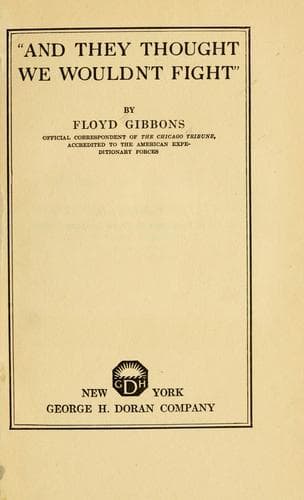
"And they thought we wouldn't fight"Gibbons, Floyd Phillips
History
"And they thought we wouldn't fight"
Gibbons, Floyd Phillips
World War, 1914-1918 -- Campaigns -- Western Front; World War, 1914-1918 -- Personal narratives
To the General's right, as he faced the Place, were the trees and
greenery of the broad Champs Elysees. On his left were the fountains and
the gardens of the Tuilleries. At the further end of the Place, five
hundred feet straight in front of him, were the banks and the ornamental
bridges of the Seine, beyond which could be seen the columned facade of
the Chambre des Deputies, and above and beyond that, against the blue
sky of a late June afternoon, rose the majestic golden dome of the
Invalides, over the tomb of Napoleon.
General Pershing looked down upon the sea of faces turned up toward him,
and then it seemed that nature desired to play a part in the ceremony of
that great day. A soft breeze from the Champs Elysees touched the
cluster of flags on the General's right and from all the Allied emblems
fastened there it selected one flag.
The breeze tenderly caught the folds of this flag and wafted them across
the balcony on which the General bowed. He saw and recognised that flag.
He extended his hand, caught the flag in his fingers and pressed it to
his lips. All France and all America represented in that vast throng
that day cheered to the mighty echo when Pershing kissed the tri-colour
of France.
It was a tremendous, unforgettable incident. It was exceeded by no other
incident during those days of receptions and ceremonies, except one.
That was an incident which occurred not in the presence of thousands,
but in a lonely old burial ground on the outskirts of Paris. This
happened several days after the demonstration in the Place de la
Concorde.
On that day of bright sunshine, General Pershing and a small party of
officers, French and American, walked through the gravel paths of Picpus
Cemetery in the suburbs of Paris, where the bodies of hundreds of those
who made the history of France are buried.
Several French women in deep mourning courtesied as General Pershing
passed. His party stopped in front of two marble slabs that lay side by
side at the foot of a granite monument. From the General's party a
Frenchman stepped forward and, removing his high silk hat, he addressed
the small group in quiet, simple tones and well-chosen English words. He
was the Marquis de Chambrun. He said:
"On this spot one can say that the historic ties between our nations
are not the result of the able schemes of skilful diplomacy. No, the
principles of liberty, justice and independence are the glorious
links between our nations.
"These principles have enlisted the hearts of our democracies. They
have made the strength of their union and have brought about the
triumph of their efforts.
"To-day, when, after nearly a century and a half, America and France
are engaged in a conflict for the same cause upon which their early
friendship was based, we are filled with hope and confidence.
Public-domain text, read in full here on John Shaqi.
Reviews
Reviews
No reviews yet
Be the first to share your thoughts on this work.
Join the Discussion
Join the discussion
Sign in to leave a comment or review.
Sign InorCreate an account