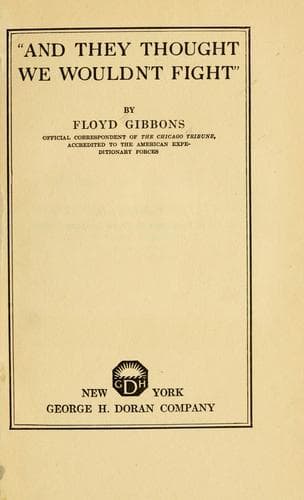
"And they thought we wouldn't fight"Gibbons, Floyd Phillips
History
"And they thought we wouldn't fight"
Gibbons, Floyd Phillips
World War, 1914-1918 -- Campaigns -- Western Front; World War, 1914-1918 -- Personal narratives
These two opening sorties produced a flood of others. The most common
enquiry was: "What's the name of this place?" and "Is this France or
England?" When answers were made to these questions, the recipients of
the information, particularly if they happened to be "old-timers in the
army," would respond by remarking, "Well, it's a damn sight better than
the Mexican border."
As our men came over the ship's side and down the runways, there was no
great reception committee awaiting them. Among the most interested
spectators of the event were a group of stolid German prisoners of war
and the two French soldiers guarding them. The two Frenchmen talked
volubly with a wealth of gesticulation, while the Germans maintained
their characteristic glumness.
The German prisoners appeared to be anything but discouraged at the
sight. Some of them even wore a smile that approached the supercilious.
With some of them that smile seemed to say: "You can't fool us. We know
these troops are not Americans. They are either Canadians or Australians
coming from England. Our German U-boats won't let Americans cross the
ocean."
Some of those German prisoners happened to have been in America before
the war. They spoke English and recognised the uniforms of our men.
Their silent smiles seemed to say: "Well, they don't look so good at
that. We have seen better soldiers. And, besides, there is only a
handful of them. Not enough can come to make any difference. Anyhow, it
is too late now. The war will be over before any appreciable number can
get here."
But the stream of khaki continued to pour out of the ship's side.
Company after company of our men, loaded down with packs and full field
equipment, lined up on the dock and marched past the group of German
prisoners.
"We're passing in review for you, Fritzie," one irrepressible from our
ranks shouted, as the marching line passed within touching distance of
the prisoner group. The Germans responded only with quizzical little
smiles and silence.
Escorted by our own military bands, the regiments marched through the
main street of the village. The bands played "Dixie"--a new air to
France. The regiments as a whole did not present the snappy, marching
appearance that they might have presented. There was a good reason for
this. Sixty per cent. of them were recruits. It had been wisely decided
to replace many of the old regular army men in the ranks with newly
enlisted men, so that these old veterans could remain in America and
train the new drafts.
Public-domain text, read in full here on John Shaqi.
Reviews
Reviews
No reviews yet
Be the first to share your thoughts on this work.
Join the Discussion
Join the discussion
Sign in to leave a comment or review.
Sign InorCreate an account