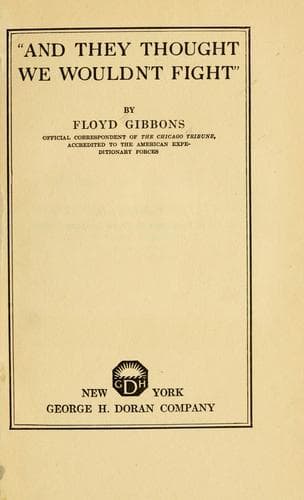
"And they thought we wouldn't fight"Gibbons, Floyd Phillips
History
"And they thought we wouldn't fight"
Gibbons, Floyd Phillips
World War, 1914-1918 -- Campaigns -- Western Front; World War, 1914-1918 -- Personal narratives
The American negro's mouth fell open. For a minute he looked startled,
and then he bulged one large round white eye suspiciously at the French
black, while he inwardly debated on the possibility that he had become
suddenly colour blind. Having reassured himself, however, that his
vision was not at fault, he made a sudden decision and started on a new
tack.
"Now, never mind that high-faluting language," he said. "You all just
tell me what you know about this here wah and quit you' putting on
aihs."
The puzzled French negro could only reply with another explosion of
French interrogations, coupled with vigorous gesticulations. The
American negro tried to talk at the same time and both of them
endeavouring to make the other understand, increased the volumes of
their tones until they were standing there waving their arms and
shouting into one another's faces. The American negro gave it up.
"My Gawd," he said, shaking his head as he recrossed the street and
joined his comrades, "this is shore some funny country. They got the
mos' ignorantest niggers I ever saw."
Still, those American blacks were not alone in their difficulties over
the difference in languages. I discussed the matter with one of our
white regulars who professed great experience, having spent almost one
entire day on mutual guard with a French sentry over a pile of baggage.
"You know," he said, "I don't believe these Frenchies ever will learn to
speak English."
Our veterans from Mexico and the border campaigns found that their
smattering of Spanish did not help them much. But still every one seemed
to manage to get along all right. Our soldiers and the French soldiers
in those early days couldn't understand each other's languages, but they
could understand each other.
This strange paradox was analysed for me by a young American Lieutenant
who said he had made a twelve-hour study of the remarkable camaraderie
that had immediately sprung up between the fighting men of France and
the fighting men of America. In explaining this relationship, he said:
"You see, we think the French are crazy," he said, "and the French know
damn well we are."
Those of our men who had not brought small French and English
dictionaries with them, made hurried purchases of such handy articles
and forthwith began to practice. The French people did likewise.
I saw one young American infantryman seated at a table in front of one
of the sidewalk cafes on the village square. He was dividing his
attention between a fervent admiration of the pretty French waitress,
who stood smiling in front of him, and an intense interest in the pages
of his small hand dictionary.
She had brought his glass of beer and he had paid for it, but there
seemed to be a mutual urge for further conversation. The American would
look first at her and then he would look through the pages of the book
again. Finally he gave slow and painful enunciation of the following
request:
"Mad-am-moy-sell, donnie moy oon baysa."
Public-domain text, read in full here on John Shaqi.
Reviews
Reviews
No reviews yet
Be the first to share your thoughts on this work.
Join the Discussion
Join the discussion
Sign in to leave a comment or review.
Sign InorCreate an account