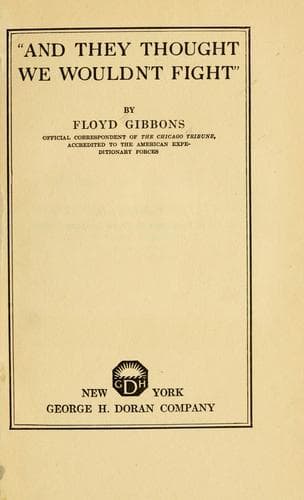
"And they thought we wouldn't fight"Gibbons, Floyd Phillips
History
"And they thought we wouldn't fight"
Gibbons, Floyd Phillips
World War, 1914-1918 -- Campaigns -- Western Front; World War, 1914-1918 -- Personal narratives
Instantly one of the prisoners' hands began to furtively investigate the
packages revealed by the break. The other prisoners busied themselves as
if preparing to lift the box again. The first German pulled a spoon from
his bootleg, plunged it into the crevice in the broken box and withdrew
it heaped with granulated sugar. With a quick movement he conveyed the
stolen sweet to his mouth and that gapping orifice closed quickly on the
sugar, while his stoical face immediately assumed its characteristic
downcast look. He didn't dare move his lips or jaws for fear of
detection.
Of course these Germans had been receiving but a scant ration of sugar,
but their lot had been no worse than that of the French soldiers
guarding them previously, who got no sugar either. American soldiers
then guarding those prisoners reported only a few of them for
confinement for these human thefts.
Surreptitiously, the American guards would sometimes leave cigarettes
where the prisoners could get them, and even though the action did
violate the rules of discipline, it helped to develop further the human
side of the giver and the recipient and at the same time had the result
of making the prisoners do more work for their new guards.
It should be specially stated that lenience could not and was not
extended to the point of fraternisation. But the relationship that
seemed to exist between the German prisoners and American soldiers at
that early date revealed undeniably the absence of any mutual hate.
Around one packing case on the dock I saw, one day, a number of German
prisoners who were engaged in unpacking bundles from America, and
passing them down a line of waiting hands that relayed them to a freight
car. One of the Germans leaning over the case straightened up with a
rumpled newspaper in his hand. He had removed it from a package. A look
of indescribable joy came across his face.
"Deutscher, Deutscher," he cried, pointing to the Gothic type. The paper
was a copy of the New York _Staats-Zeitung_.
The lot of those prisoners was not an unhappy one. To me it seemed very
doubtful whether even a small percentage of them would have accepted
liberty if it carried with it the necessity of returning to German
trenches.
Those men knew what war was. They had crossed No Man's Land. Now they
were far back from the blazing front in a comparatively peaceful country
beyond the sound of the guns. If their lot at that time was to be
characterised as "war," then in the opinion of those Germans, war was
not what Sherman said it was.
Their attitude more resembled that of the unkissed spinster who was
taken captive when the invading army captured the town. She flung
herself into the arms of the surprised commander of the invaders and
smilingly whispered, "War is war."
Public-domain text, read in full here on John Shaqi.
Reviews
Reviews
No reviews yet
Be the first to share your thoughts on this work.
Join the Discussion
Join the discussion
Sign in to leave a comment or review.
Sign InorCreate an account