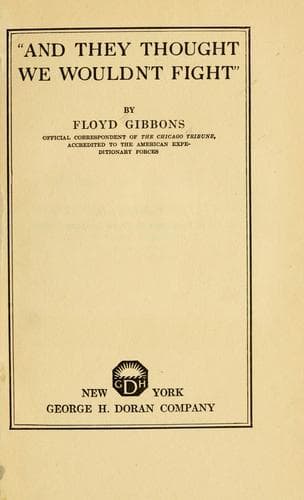
"And they thought we wouldn't fight"Gibbons, Floyd Phillips
History
"And they thought we wouldn't fight"
Gibbons, Floyd Phillips
World War, 1914-1918 -- Campaigns -- Western Front; World War, 1914-1918 -- Personal narratives
The troops were billeted in a string of small villages that comprised
one side of the letter V. French troops and instructing officers
occupied the other converging line of the letter. Between the two lines
was the area in which our men trained. Where the two lines converged
was the town of Gondercourt, the headquarters of Major General Seibert,
the Commander of the first American division in France.
The area had long since been stripped of male civilian population that
could be utilised for the French ranks. The war had taken the men and
the boys, but had left the old people and children to till the fields,
tend the cattle, prune the hedges and trim the roads.
With the advent of our troops, the restful scene began to change.
Treeless ridges carpeted with just enough green to veil the rocky
formation of the ground began to break out with a superficial rash of
the colour of fresh earth. In rows and circles, by angles and zigzags,
the training trenches began to take form daily under the pick and shovel
exercises of French and Americans working side by side.
Along the white roads, clay-coloured rectangles that moved evenly, like
brown caravans, represented the marching units of United States troops.
The columns of bluish-grey that passed them with shorter, quicker steps,
were companies of those tireless Frenchmen, who after almost three years
of the front line real thing, now played at a mimic war of make-believe,
with taller and heavier novitiates.
Those French troops were Alpine Chasseurs--the famous Blue Devils. They
wore dark blue caps, which resemble tam o'shanters, but are not. They
were proud of the distinction which their uniform gave them. They were
proud of their great fighting records. One single battalion of them
boasted that of the twenty-six officers who led it into the first fight
at the opening of the war, only four of them existed.
It was a great advantage for our men to train under such instructors.
Correspondents who had been along the fronts before America's entry
into the war, had a great respect for the soldierly capacity of these
same fighting Frenchmen; not only these sturdy young sons of France who
wore the uniform, but the older French soldiers--ranging in age from
forty to fifty-five years--who had been away to the fronts since the
very beginning of the war.
We had seen them many, many times. Miles upon miles of them, in the
motor trucks along the roads. Twenty of them rode in each truck. They
sat on two side benches facing the centre of the trucks. They were men
actually bent forward from the weight of the martial equipment strapped
to their bodies. They seemed to carry inordinate loads--knapsacks,
blanket roll, spare shoes, haversacks, gas masks, water bottles,
ammunition belts, grenade aprons, rifle, bayonet and helmet.
Public-domain text, read in full here on John Shaqi.
Reviews
Reviews
No reviews yet
Be the first to share your thoughts on this work.
Join the Discussion
Join the discussion
Sign in to leave a comment or review.
Sign InorCreate an account