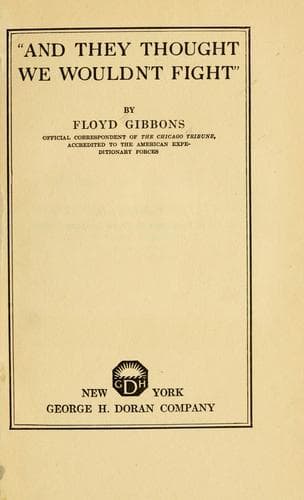
"And they thought we wouldn't fight"Gibbons, Floyd Phillips
History
"And they thought we wouldn't fight"
Gibbons, Floyd Phillips
World War, 1914-1918 -- Campaigns -- Western Front; World War, 1914-1918 -- Personal narratives
Thus it was that our first American contingent in France was in training
for something more than service on the line. It rapidly qualified into
an expert corps from which large numbers of capable American instructors
were later withdrawn and used for the training of our millions of men
that followed.
This achievement was only accomplished by the exercise of strict
disciplinarian measures by every American officer in the then small
expedition. One day, in the early part of August, 1917, a whirlwind
swept through the string of French villages where the first contingent
was training.
The whirlwind came down the main road in a cloud of dust. It sped on the
fleeting tires of a high-powered motor which flew from its dust-grey
hood a red flag with two white stars. It blew into the villages and out,
through the billets and cook tents, mess halls, and picket lines. The
whirlwind was John J. Pershing.
The commander-in-chief "hit" the training area early in the morning and
his coming was unannounced. Before evening he had completed a stern
inspection which had left only one impression in the minds of the
inspected, and that impression was to the effect that more snap and pep,
more sharpness and keenness were needed.
At the conclusion of the inspection all of the officers of the
contingent were agreeing that the whirlwind visitation was just what had
been needed to arouse the mettle and spirit in an organisation comprised
of over fifty per cent. raw recruits. Many of the officers themselves
had been included in the pointed criticisms which the commander directed
against the persons and things that met disfavour in his eyes.
The night following that inspection or "raid," as it was called, it
would have been safe to say that nowhere in the area was there a recruit
who did not know, in a manner that he would not forget, the correct
position of a soldier--the precise, stiff, snappy attitude to be
presented when called to attention. The enlisted men whose heels did not
click when they met, whose shoulders slouched, whose chins missed the
proper angle, whose eyes were not "front" during the inspection,
underwent embarrassing penalties, calculated to make them remember.
"Have this man fall out," General Pershing directed, as he stood before
a recruit whose attitude appeared sloppy; "teach him the position of a
soldier and have him stand at attention for five minutes."
One company which had prided itself upon having some of the best
embryonic bomb-throwers in the contingent, contributed a number of
victims to the above penalties, and as the General's train of
automobiles swirled out of the village, the main street seemed to be
dotted with silent khaki-clad statues doing their five minute sentences
of rigidity.
"What about your men's shoes?" General Pershing asked a captain sharply,
while he directed his eyes along a company line of feet whose casings
seemed to be approaching the shabby.
"We need hobnails, sir," replied the captain.
Public-domain text, read in full here on John Shaqi.
Reviews
Reviews
No reviews yet
Be the first to share your thoughts on this work.
Join the Discussion
Join the discussion
Sign in to leave a comment or review.
Sign InorCreate an account