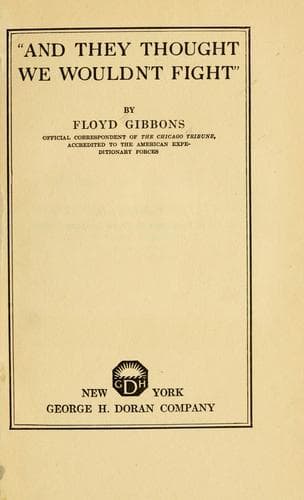
"And they thought we wouldn't fight"Gibbons, Floyd Phillips
History
"And they thought we wouldn't fight"
Gibbons, Floyd Phillips
World War, 1914-1918 -- Campaigns -- Western Front; World War, 1914-1918 -- Personal narratives
The sound seemed to indicate that the planes were flying low. The
American ranks knew that something was going on immediately above them.
They did not know what it was, but it seems needless to state that they
wanted to know. Still the ranks stood as stiff as rows of clay-coloured
statues.
An almost irresistible impulse to look upward, a strong instinctive
urging to see the danger that impended, and the stern regulations of
"eyes front" that goes with the command "attention," comprised the
elements of conflict that went on in each of the thousand heads in that
battalion line.
In front of each platoon, the lieutenants and captains stood with the
same rigid eyes front facing the men. If one of the company officers had
relaxed to the extent of taking one fleeting upward glance, it is
doubtful whether the men could have further resisted the same
inclination, but not a man shifted his gaze from the direction
prescribed by the last command.
One plane passed closely overhead and nothing happened. Three more
followed and still no bombs fell, and then the tense incident was closed
by the calling out of the order of the march and, in squads of four, the
battalion wheeled into the road and marched back to billets.
As one company went by singing (talking was permitted upon the freedom
of routstep), I heard one of the men say that he had thought all along
that the officers would not have made them stand there at attention if
the danger had not been over.
"As far as I knew, it was over," a comrade added. "It was right over my
head." And in this light manner the men forgot the incident as they
resumed their marching song.
When Mr. W. Hollenzollern of Potsdam put singing lessons in the
curriculum of his soldiers' training, a tremor of military giggling was
heard around the world. But in August, 1914, when Mars smiled at the
sight of those same soldiers, marching across the frontiers east, south
and west, under their throaty barrage of "Deutschland, Deutschland, Ueber
Alles," the derisive giggles completely died out. It immediately became
a case of he who laughs first, lives to yodel.
The American forces then in training took advantage of this. They not
only began to sing as they trained, but they actually began to be
trained to sing. Numerous company commanders who had held strong
opinions against this vocal soldiering, changed their minds and
expressed the new found conviction that the day was past when singing
armies could be compared solely with male coryphees who hold positions
well down stage and clink empty flagons of brown October ale.
"It's a great idea," a company commander told me. "We learned it from
the Blue Devils. They are the toughest set of undersized gentry that I
have run into in France. They have forearms as big as three-inch shells,
and as hard. Their favourite pastime is juggling hand-grenades that
can't possibly explode unless they just lightly touch one another.
Public-domain text, read in full here on John Shaqi.
Reviews
Reviews
No reviews yet
Be the first to share your thoughts on this work.
Join the Discussion
Join the discussion
Sign in to leave a comment or review.
Sign InorCreate an account