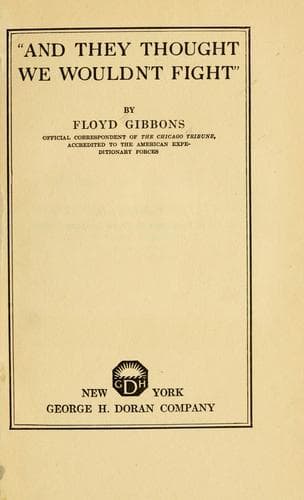
"And they thought we wouldn't fight"Gibbons, Floyd Phillips
History
"And they thought we wouldn't fight"
Gibbons, Floyd Phillips
World War, 1914-1918 -- Campaigns -- Western Front; World War, 1914-1918 -- Personal narratives
No Roman conqueror at the head of his invading legions ever rode through
that triumphal arch with greater pride than rode our little captain
at the head of his battery. Our little captain was in stature the
smallest man in our battery, but he compensated for that by riding the
tallest horse in the battery.
He carried his head at a jaunty angle. He wore his helmet at a nifty
tilt, with the chin strap riding between his underlip and his dimpled,
upheld chin. He carried his shoulders back, and his chest out. The reins
hung gracefully in his left hand, and he had assumed a rather
moving-picture pose of the right fist on his right hip. Behind him flew
the red guidon, its stirruped staff held stiffly at the right arm's
length by the battery standard bearer.
Both of them smiled--expansive smiles of pride--into the clicking lens
of my camera. I forgave our little captain for his smile of pride. I
knew that six weeks before that very day our little captain had fitted
into the scheme of civilian life as a machinery salesman from Indiana.
And there that day, he rode at the head of his two hundred and fifty
fighting men and horses, at the head of his guns, rolling down that road
in France on the way to the front.
In back of him and towering upward, was that historic rock that had
known the tread and passage of countless martial footsteps down through
the centuries. Behind him, the gun carriages rattled through the
frowning portal. Oh, if the folks back on the Wabash could have seen him
then!
We wound through the crooked narrow streets of Besancon, our steel-tired
wheels bounding and banging over the cobblestones. Townsfolk waved to us
from windows and doorways. Old women in the market square abandoned
their baskets of beet roots and beans to flutter green stained aprons in
our direction. Our column was flanked by clattering phalanxes of
wooden-shoed street gamins, who must have known more about our movements
than we did, because they all shouted, "Gude-bye."
Six weeks' familiarity between these same artillerymen on town leave and
these same urchins had temporised the blind admiration that caused them
first to greet our men solely with shouts of "_Vive les Americains_."
Now that they knew us better, they alternated the old greeting with
shouts of that all-meaning and also meaningless French expression, "Oo
la la."
Our way led over the stone, spanned bridge that crossed the sluggish
river through the town, and on to the hilly outskirts where mounted
French guides met and directed us to the railroad loading platform.
The platform was a busy place. The regimental supply company which was
preceding us over the road was engaged in forcibly persuading the last
of its mules to enter the toy freight cars which bore on the side the
printed legend, "Hommes 40, Chevaux 8."
Public-domain text, read in full here on John Shaqi.
Reviews
Reviews
No reviews yet
Be the first to share your thoughts on this work.
Elsewhere in the archive
Join the Discussion
Join the discussion
Sign in to leave a comment or review.
Sign InorCreate an account