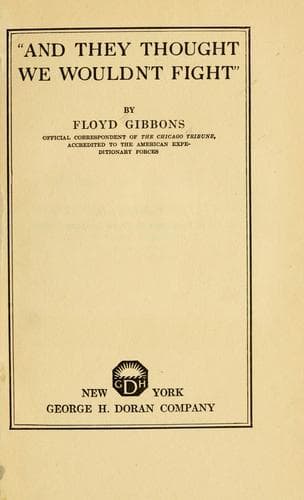
"And they thought we wouldn't fight"Gibbons, Floyd Phillips
History
"And they thought we wouldn't fight"
Gibbons, Floyd Phillips
World War, 1914-1918 -- Campaigns -- Western Front; World War, 1914-1918 -- Personal narratives
Several arclights and one or two acetylene flares illuminated the scene.
It was raining fitfully, but not enough to dampen the spirits of the Y.
M. C. A. workers who wrestled with canvas tarpaulins and foraged
materials to construct a make-shift shelter for a free coffee and
sandwich counter.
Their stoves were burning brightly and the hurriedly erected stove
pipes, leaning wearily against the stone wall enclosing the quay, topped
the wall like a miniature of the sky line of Pittsburgh. The boiling
coffee pots gave off a delicious steam. In the language of our battery,
the "Whime say" delivered the goods.
During it all the mules brayed and the supply company men swore. Most
humans, cognizant of the principles of safety first, are respectful of
the rear quarters of a mule. We watched one disrespecter of these
principles invite what might have been called "mulecide" with utter
contempt for the consequences. He deliberately stood in the dangerous
immediate rear of one particularly onery mule, and kicked the mule.
His name was "Missouri Slim," as he took pains to inform the object of
his caress. He further announced to all present, men and mules, that he
had been brought up with mules from babyhood and knew mules from the
tips of their long ears to the ends of their hard tails.
The obdurate animal in question had refused to enter the door of the car
that had been indicated as his Pullman. "Missouri Slim" called three
other ex-natives of Champ Clark's state to his assistance. They
fearlessly put a shoulder under each of the mule's quarters. Then they
grunted a unanimous "heave," and lifted the struggling animal off its
feet. As a perfect matter of course, they walked right into the car with
him with no more trouble than if he had been an extra large bale of hay.
"Wonderful mule handling in this here army," remarked a quiet,
mild-mannered man in uniform, beside whom I happened to be standing. He
spoke with a slow, almost sleepy, drawl. He was the new veterinarian of
the supply company, and there were a number of things that were new to
him, as his story revealed. He was the first homesick horse doctor I
ever met.
"I come from a small town out in Iowa," he told me. "I went to a
veterinary college and had a nice little practice,--sorter kept myself
so busy that I never got much of a chance to think about this here war.
But one day, about two months ago, I got a letter from the War
Department down in Washington.
"They said the hoss doctor college had given them my name as one of the
graduates and the letter said that the War Department was making out a
list of hoss doctors. The letter asked me to fill out the blank and send
it to Washington.
"'Joe,' my wife says to me, 'this here is an honour that the country is
paying to you. The Government just wants the names of the patriotic
professional citizens of the country.' So we filled out the blank and
mailed it and forgot all about it.
Public-domain text, read in full here on John Shaqi.
Reviews
Reviews
No reviews yet
Be the first to share your thoughts on this work.
Elsewhere in the archive
Join the Discussion
Join the discussion
Sign in to leave a comment or review.
Sign InorCreate an account