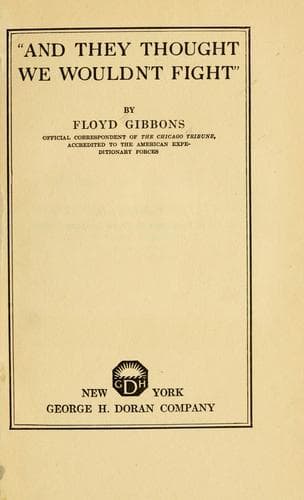
"And they thought we wouldn't fight"Gibbons, Floyd Phillips
History
"And they thought we wouldn't fight"
Gibbons, Floyd Phillips
World War, 1914-1918 -- Campaigns -- Western Front; World War, 1914-1918 -- Personal narratives
I opened one side door just a crack and looked out. The darkness above
blossomed with blinding blotches of fire that flashed on and off. It
seemed as though the sky were a canopy of black velvet perforated with
hundreds of holes behind which dazzling lights passed back and forth,
flashing momentary gleams of brilliance through the punctures. Again,
this vision would pass as a luminous dripping mass would poise itself on
high and cast a steady white glare that revealed clusters of grey smoke
puffs of exploded shrapnel.
We had to close the door because the flashes added to the terror of the
horses, but the aerial activity passed almost as suddenly as it had come
and left our train untouched. As the raiding planes went down the wind,
followed always by the poppings of the anti-aircraft guns, the sound of
the conflict grew distant. We got control over the horses although they
still trembled with fright.
There came another rap at the door and I hurriedly accepted the
captain's invitation to accompany him forward to a first-class coach
where I spent the remainder of the night stretched out on the cushions.
As our train resumed its way into the darkness, I dreamed of racing
before a stampede of wild horses.
CHAPTER VII
INTO THE LINE--THE FIRST AMERICAN SHOT IN THE WAR
A damp, chill, morning mist made the dawn even greyer as our battery
train slid into a loading platform almost under the walls of a large
manufacturing plant engaged in producing war materials.
In spite of the fact that the section chiefs reported that not a man had
been injured, and not so much as a leg broken in the crowded horse cars,
every man in the battery now declared the absence of any doubt but the
air raid had been directly aimed at Battery A.
"There might be a spy in this here very outfit," said 'Texas' Tinsdale,
the battery alarmist. "Else how could them German aviators have known
that Battery A was on the road last night? They knew we was on the way
to the front and they tried to get us."
"Hire a hall," shouted the gruffy top sergeant. "We've got two hours to
unload. A lot of you fireside veterans get busy. Gun crews get to work
on the flats and drivers unload horses. No chow until we're ready to
move out."
The sign on a station lamp-post told us the name of the town. It was
Jarville. But it jarred nothing in our memories. None of us had ever
heard of it before. I asked the captain where we were.
"Just about thirty miles behind the front," he replied. "We are moving
up to our last billets as soon as we unload and feed."
The horses had made the ride wearing their harness, some of which had
become entangled and broken in transit. A number of saddles had slipped
from backs and were down behind forelegs.
"We're learning something every minute," the captain exclaimed.
"American army regulations call for the removal of all harness from the
horses before they are put into the cars, but the French have learned
that that is a dangerous practice over here.
Public-domain text, read in full here on John Shaqi.
Reviews
Reviews
No reviews yet
Be the first to share your thoughts on this work.
Elsewhere in the archive
Join the Discussion
Join the discussion
Sign in to leave a comment or review.
Sign InorCreate an account