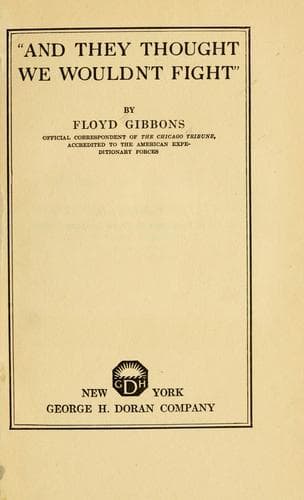
"And they thought we wouldn't fight"Gibbons, Floyd Phillips
History
"And they thought we wouldn't fight"
Gibbons, Floyd Phillips
World War, 1914-1918 -- Campaigns -- Western Front; World War, 1914-1918 -- Personal narratives
"You can't unload unharnessed horses and get them hitched to the guns as
quick as you can harnessed horses. The idea is this. We're pretty close
behind the lines. A German air party might make this unloading platform
a visit at any time and if any of them are in the air and happen to see
us unloading, they'd sure call on us.
"The French have learned that the only way to make the best of such a
situation, if it should arise, is to have the horses already harnessed
so that they can be run out of the cars quickly, hitched to the guns in
a jiffy and hurried away. If the horses are in the cars unharnessed, and
all of the harness is being carried in other cars, confusion is
increased and there is a greater prospect of your losing your train,
horses, guns and everything from an incendiary bomb, not to mention low
flying machine work."
His explanation revealed a promising attitude that I found in almost all
American soldiers of all ranks that I had encountered up to that time in
France. The foundation of the attitude was a willingness to admit
ignorance of new conditions and an eagerness to possess themselves of
all knowledge that the French and British had acquired through bitter
and costly experience.
Further than that, the American inclination pushed the soldier students
to look beyond even those then accepted standards. The tendency was to
improve beyond the French and British, to apply new American principles
of time or labour-saving to simple operation, to save man-power and
horseflesh by sane safety appliances, to increase efficiency, speed,
accuracy--in a word, their aim was to make themselves the best fighting
men in the Allied cause.
One instance of this is worthy of recounting. I came upon the young
Russian who was the battery saddler. He was a citizen of the United
States whose uniform he wore, but he was such a new citizen, that he
hardly spoke English. I found him handling a small piece of galvanised
iron and a horse shoe. He appeared to be trying to fit the rumpled piece
of metal into the shoe.
In his broken English he explained that he was trying to fashion a light
metal plate that could be easily placed between a horse's shoe and the
hoof, to protect the frog of the foot from nails picked up on the road.
With all soldiers wearing hobnailed boots, the roads were full of those
sharp bits of metal which had caused serious losses of horseflesh
through lameness and blood poisoning.
* * * * *
The unloading had continued under the eyes of smiling French girls in
bloomers who were just departing from their work on the early morning
shift in the munition factory beside the station. These were the first
American soldiers they had seen and they were free to pass comment upon
our appearance. So were the men of Battery A, who overlooked the oiled,
grimed faces and hands of the bloomered beauties, and announced the
general verdict that "they sure were fat little devils."
Public-domain text, read in full here on John Shaqi.
Reviews
Reviews
No reviews yet
Be the first to share your thoughts on this work.
Elsewhere in the archive
Join the Discussion
Join the discussion
Sign in to leave a comment or review.
Sign InorCreate an account