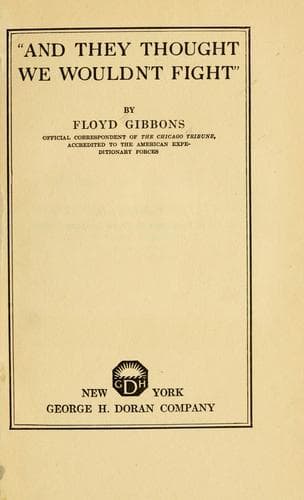
"And they thought we wouldn't fight"Gibbons, Floyd Phillips
History
"And they thought we wouldn't fight"
Gibbons, Floyd Phillips
World War, 1914-1918 -- Campaigns -- Western Front; World War, 1914-1918 -- Personal narratives
The unloading completed, a scanty snack consisting of two unbuttered
slices of white bread with a hunk of cold meat and maybe the bite of an
onion, had been put away by the time the horses' nose bags were empty.
With a French guide in the lead, we moved off the platform, rattled
along under a railroad viaduct, and down the main street of Jarville,
which was large enough to boast street car tracks and a shell-damaged
cathedral spire.
The remaining townsfolk had lived with the glare and rumble of the front
for three years now and the passage back and forth of men and horses and
guns hardly elicited as much attention as the occasional promenade of a
policeman in Evanston, Illinois. But these were different men that rode
through those streets that day.
This was the first battery of American artillery that had passed that
way. This was an occasion and the townspeople responded to it. Children,
women and old men chirped "vivas," kissed hands, bared heads and waved
hats and aprons from curb and shop door and windows overhead.
There was no cheering, but there were smiles and tears and "God bless
you's." It was not a vociferous greeting, but a heart-felt one. They
offered all there was left of an emotion that still ran deep and strong
within but that outwardly had been benumbed by three years of nerve-rack
and war-weariness.
Onward into the zone of war we rode. On through successive battered
villages, past houses without roofs, windows with shattered panes, stone
walls with gaping shell holes through them, churches without steeples,
our battery moved toward the last billeting place before entering the
line.
This was the ancient town of Saint-Nicolas-du-Port on the banks of the
river Meurthe. Into the Place de la Republic of the town the battery
swung with a clamorous advance guard of schoolchildren and street
gamins.
The top sergeant who had preceded the battery into the town, galloped up
to the captain upon our entry and presented him with a sheaf of yellow
paper slips, which bore the addresses of houses and barns and the
complements of men and horses to be quartered in each. This was the
billeting schedule provided by the French major of the town. The guns
were parked, the horses picketed and the potato peelers started on their
endless task. The absence of fuel for the mess fires demanded immediate
correction.
It was a few minutes past noon when the captain and I entered the office
of the French Town Major. It was vacant. The officers were at
_dejeuner_, we learned from an old woman who was sweeping the
commandant's rooms. Where?--Ah, she knew not. We accosted the first
French officer we met on the street.
"Where does the Town Major eat?" the Captain inquired in his best
Indianapolis French. After the customary exchange of salutes,
introductions, handshakes and greetings, the Frenchman informed us that
Monsieur Le Commandant favoured the _pommard_, that Madame Larue served
at the Hotel de la Fountaine.
Public-domain text, read in full here on John Shaqi.
Reviews
Reviews
No reviews yet
Be the first to share your thoughts on this work.
Elsewhere in the archive
Join the Discussion
Join the discussion
Sign in to leave a comment or review.
Sign InorCreate an account