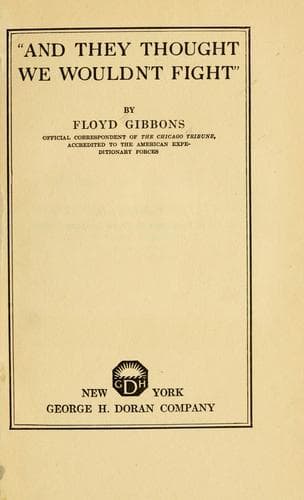
"And they thought we wouldn't fight"Gibbons, Floyd Phillips
History
"And they thought we wouldn't fight"
Gibbons, Floyd Phillips
World War, 1914-1918 -- Campaigns -- Western Front; World War, 1914-1918 -- Personal narratives
Early the next morning, our battery pulled out for the front. We were
bound for the line. We took the roads out of Saint Nicolas to the east,
making our way toward that part of the front that was known as the
Luneville sector. Our way lay through the towns of Dombasle,
Sommerviller, Maixe, Einville, Valhey, Serres, to the remains of the
ruined village of Hoeville.
The sector runs almost along the border between France and old Lorraine,
occupied by the Germans since 1870. Even the names of the old French
towns beyond the border had been changed to German in the effort of the
Prussians to Germanise the stolen province.
It was in this section during the few days just prior to the outbreak of
the war that France made unwise demonstration of her disinclination
toward hostilities with Germany. Every soldier in France was under arms,
as was every soldier in Europe. France had military patrols along her
borders. In the French chamber of deputies, the socialists had rushed
through a measure which was calculated to convince the German people
that France had no intentions or desire of menacing German territory. By
that measure every French soldier was withdrawn from the Franco-German
border to a line ten miles inside of France. The German appreciation of
this evidence of peacefulness was manifested when the enemy, at the
outbreak of the war, moved across the border and occupied that ten-mile
strip of France.
France had succeeded in driving the enemy back again in that part of
Lorraine, but only at the cost of many lives and the destruction of many
French towns and villages. Since the close of the fighting season of
1914, there had been little or no progress on either side at this point.
The opposing lines here had been stationary for almost three years and
it was known on both sides as a quiet sector.
The country side was of a rolling character, but very damp. At that
season of the year when our first American fighting men reached the
Western front, that part of the line that they occupied was particularly
muddy and miserable.
Before nine o'clock that morning as we rode on to the front, the
horse-drawn traffic, including our battery, was forced to take the side
of the road numerous times to permit the passage of long trains of motor
trucks loaded down with American infantrymen, bound in the same
direction.
Most of the motor vehicles were of the omnibus type. A number of them
were worthy old double-deckers that had seen long years of peaceful
service on the boulevards of Paris before the war. Slats of wood ran
lengthwise across the windows of the lower seating compartment and
through these apertures young, sun-burned, American faces topped with
steel helmets, peered forth.
Some of our men reposed languidly on the rear steps of the busses or on
the tops. Most of the bus-loads were singing rollicking choruses. The
men were in good spirits. They had been cheered in every village they
had passed through on the way from their training area.
Public-domain text, read in full here on John Shaqi.
Reviews
Reviews
No reviews yet
Be the first to share your thoughts on this work.
Elsewhere in the archive
Join the Discussion
Join the discussion
Sign in to leave a comment or review.
Sign InorCreate an account