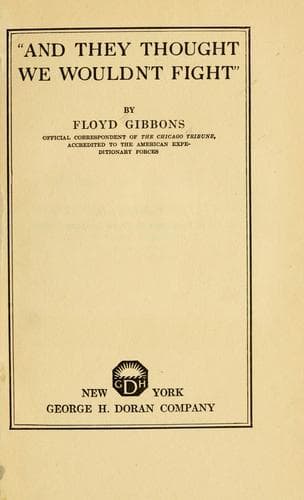
"And they thought we wouldn't fight"Gibbons, Floyd Phillips
History
"And they thought we wouldn't fight"
Gibbons, Floyd Phillips
World War, 1914-1918 -- Campaigns -- Western Front; World War, 1914-1918 -- Personal narratives
"Howdy, bowleg," was the greeting shouted by one of these motoring
mockers, who looked down on our saddled steeds, "better get a hustle on
them hayburners. We're going to be in Berlin by the time you get where
the front used to be."
"Yes, you will," replied one of the mounted artillerymen, with a
negative inflection. "You'll get a hell of a long ways without us. If
you doughboys start anything without the artillery, you'll see Berlin
through the bars of a prisoner's cage."
"Lucky pups--the artillery--nothing to do but ride," was the passing
shout of another taunter, perched high on a bus. This was an
unanswerable revision of an old taunt that the artillery used to shout
to passing infantry in the days when a foot soldier was really a foot
soldier. Then the easy-riding mounted troops, when passing an infantry
column on the road, would say, "Pretty soft for the doughboys--nothing
to do but walk."
"Times certainly have changed," one of our battery drivers felt it
necessary to remark to me in defence of his branch of the service. "But
there ain't no spark plugs or carburetors to get out of order on our
mounts.
"However, we do have our troubles. That runaway wheeler in No. 2 section
broke away from the picket line last night and Kemball and I were
detailed to hunt all over town for him.
"You know that dark, winding, narrow street, that winds down the hill
back of the cathedral. Well, it was about midnight and blacker than the
ace of spades, when Kemball and I pushed along there in the dark,
looking for that onery animal.
"Suddenly, we heard a sharp clatter on the cobblestones half a block up
the hill. It was coming our way full speed. 'Here he comes now,' said
Kemball, 'and he's galloping like hell. Jump into a doorway or he'll
climb all over us.'
"We waited there pressed against the wall in the dark as the galloping
came up to us and passed. What dy'e s'pose it was? It wasn't that
runaway horse at all. Just a couple of them French kids chasing one
another in wooden shoes."
The road to the front was a populous one. We passed numerous groups of
supply wagons carrying food and fodder up to the front lines. Other
wagons were returning empty and here and there came an ambulance with
bulgy blankets outlining the figures of stretcher cases, piled two high
and two wide. Occasionally a Y. M. C. A. runabout loaded down with
coffee pots and candy tins and driven by helmeted wearers of the Red
Triangle, would pass us carrying its store of extras to the boys up
front.
We passed through villages where manufacturing plants were still in
operation and, nearer the front, the roads lay through smaller hamlets,
shell torn and deserted, save for sentries who stood guard in wooden
coops at intersections. Civilians became fewer and fewer, although there
was not a village that did not have one or two women or children or old
men unfit for uniform.
Public-domain text, read in full here on John Shaqi.
Reviews
Reviews
No reviews yet
Be the first to share your thoughts on this work.
Elsewhere in the archive
Join the Discussion
Join the discussion
Sign in to leave a comment or review.
Sign InorCreate an account