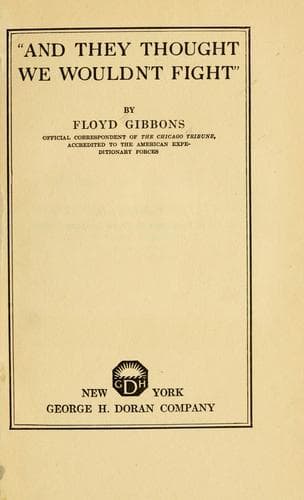
"And they thought we wouldn't fight"Gibbons, Floyd Phillips
History
"And they thought we wouldn't fight"
Gibbons, Floyd Phillips
World War, 1914-1918 -- Campaigns -- Western Front; World War, 1914-1918 -- Personal narratives
Lieutenant F. M. Mitchell, U.S.R., acted as platoon chief.
Corporal Robert Braley laid the piece.
Sergeant Elward Warthen loaded the piece.
Sergeant Frank Grabowski prepared the fuse for cutting.
Private Louis Varady prepared the fuse for cutting.
Private John J. Wodarczak prepared the fuse for cutting.
Corporal Osborne W. De Varila prepared the fuse for cutting.
Sergeant Lonnie Domonick cut the fuse.
Captain Idus R. McLendon gave the command to fire.
Sergeant Alex L. Arch fired first shot.
The missile fired was a 75 millimetre or 3-inch high-explosive shell.
The target was a German battery of 150 millimetre or 6-inch guns located
two kilometres back of the German first line trenches, and one kilometre
in back of the boundary line between France and German-Lorraine. The
position of that enemy battery on the map was in a field 100 metres west
of the town which the French still call Xanrey, but which the Germans
have called Schenris since they took it from France in 1870. Near that
spot--and damn near--fell the first American shell fired in the great
war.
* * * * *
NOTE: It is peculiar to note that I am writing this chapter at Atlantic
City, October 23rd, 1918, just one year to the day after the event. That
shot surely started something.
CHAPTER VIII
THE FIRST AMERICAN SECTOR
It was in the Luneville sector, described in the preceding chapter, that
the first American fighting men faced the Germans on the western front.
It was there that the enemy captured its first American prisoners in a
small midnight raid; it was there that we captured some prisoners of
theirs, and inflicted our first German casualties; it was there that the
first American fighting man laid down his life on the western front.
In spite of these facts, however, the occupation of those front line
posts in that sector constituted nothing more than a post-graduate
course in training under the capable direction of French instructors who
advised our officers and men in everything they did.
At the conclusion of the course, which extended over a number of weeks,
the American forces engaged in it were withdrawn from the line and
retired for a well-earned rest period and for reorganisation purposes in
areas back of the line. There they renewed equipment and prepared for
the occupation of the first all-American sector on the western front.
That sector was located in Lorraine some distance to the east of the
Luneville front. It was north and slightly west of the city of Toul. It
was on the east side of the St. Mihiel salient, then occupied by the
Germans.
Public-domain text, read in full here on John Shaqi.
Reviews
Reviews
No reviews yet
Be the first to share your thoughts on this work.
Elsewhere in the archive
Join the Discussion
Join the discussion
Sign in to leave a comment or review.
Sign InorCreate an account