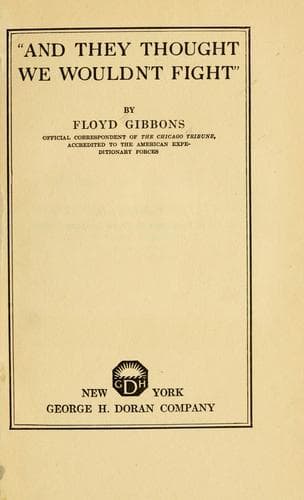
"And they thought we wouldn't fight"Gibbons, Floyd Phillips
History
"And they thought we wouldn't fight"
Gibbons, Floyd Phillips
World War, 1914-1918 -- Campaigns -- Western Front; World War, 1914-1918 -- Personal narratives
The sector occupied a position in what the French called the
Pont-a-Mousson front. Our men were to occupy an eight-mile section of
the front line trenches extending from a point west of the town of
Flirey, to a point west of the ruins of the town of Seicheprey. The
position was not far from the French stronghold of Verdun to the
northwest or the German stronghold of Metz to the northeast, and was
equidistant from both.
That line changed from French blue to American khaki on the night of
January 21st. The sector became American at midnight. I watched the men
as they marched into the line. In small squads they proceeded silently
up the road toward the north, from which direction a raw wind brought
occasional sounds resembling the falling of steel plates on the wooden
floor of a long corridor.
A half moon doubly ringed by mist, made the hazy night look grey. At
intervals, phantom flashes flushed the sky. The mud of the roadway
formed a colourless paste that made marching not unlike skating on a
platter of glue.
This was their departure for the front--this particular battalion--the
first battalion of the 16th United States Infantry. I knew, and every
man in it knew, what was before them.
Each man was in for a long tour of duty in trenches knee-deep with
melted snow and mud. Each platoon commander knew the particular portion
of that battle-battered bog into which he must lead his men. Each
company commander knew the section of shell-punctured, swamp land that
was his to hold, and the battalion commander, a veteran American
soldier, was well aware of the particular perils of the position which
his one thousand or more men were going to occupy in the very jaw-joint
of a narrowing salient.
All branches of the United States military forces may take special pride
in that first battalion that went into the new American line that night.
The commander represented the U. S. Officers Reserve Corps, and the
other officers and men were from the reserves, the regulars, West Point,
the National Guard and the National Army. Moreover, the organisation
comprised men from all parts of the United States as well as men whose
parents had come from almost every race and nationality in the world.
One company alone possessed such a babble of dialects among its new
Americans, that it proudly called itself, the Foreign Legion.
For two days the battalion had rested in the mud of the semi-destroyed
village of Ansauville, several miles back of the front. A broad, shallow
stream, then at the flood, wound through and over most of the village
site. Walking anywhere near the border of the water, one pulled about
with him pounds of tenacious, black gumbo. Dogs and hogs, ducks and
horses, and men,--all were painted with nature's handiest camouflage.
Public-domain text, read in full here on John Shaqi.
Reviews
Reviews
No reviews yet
Be the first to share your thoughts on this work.
Elsewhere in the archive
Join the Discussion
Join the discussion
Sign in to leave a comment or review.
Sign InorCreate an account